

|
| Search | Car Forums | Gallery | Articles | Helper | Air Dried Fresh Beef Dog Food | IgorSushko.com | Corporate |
|
|||||||
| Engineering/ Technical Ask technical questions about cars. Do you know how a car engine works? |
 |
 Show Printable Version | Show Printable Version |  Subscribe to this Thread
|
|
|
Thread Tools |
|
#1
 01-05-2010, 09:10 AM
|
|||
|
|||
|
Rust Question
My car has various rust spots on the body like pictured below. I plan on addressing them as soon as i can. in the meantime, will i do any more damage or accelerate the current damage by going to the car wash? i just want to get the salt off and the car and underneath the car which is a bigger concern to me.
 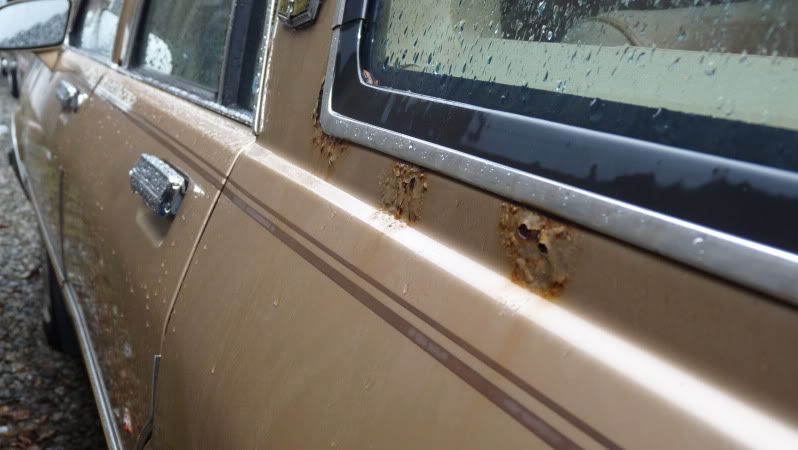 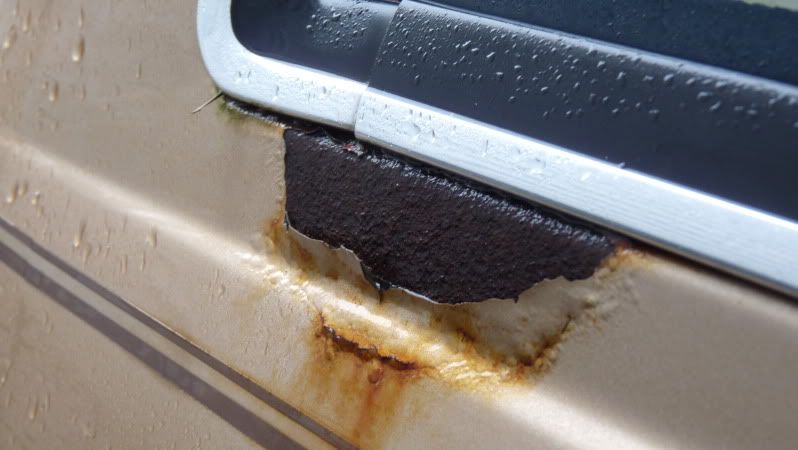 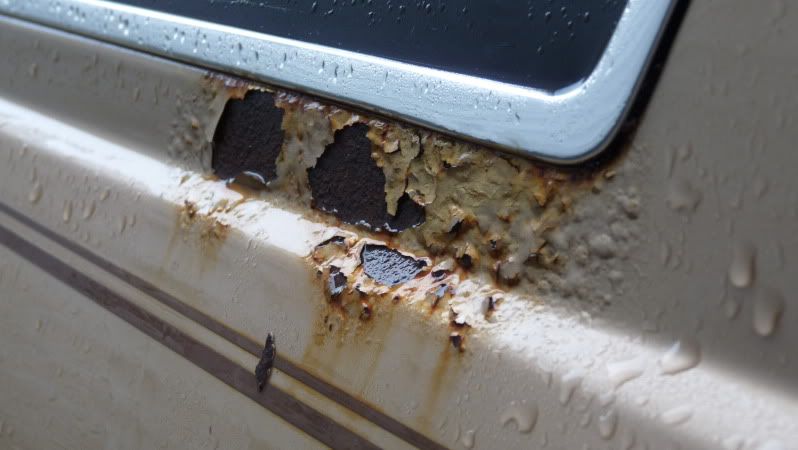 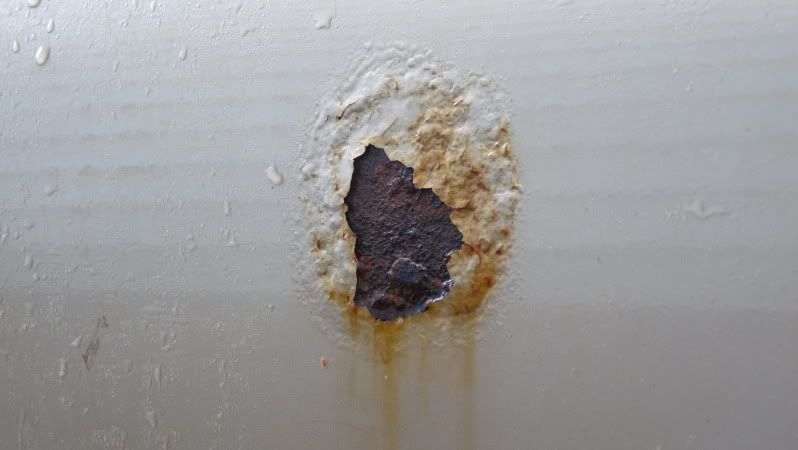 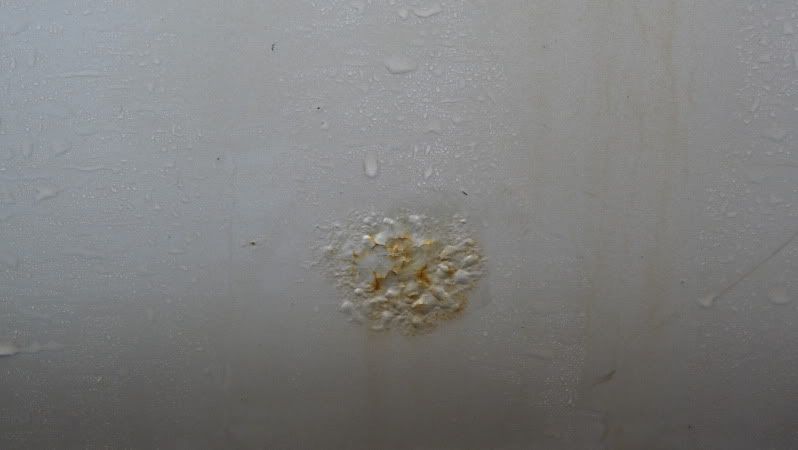 With regard to the rust repair, i have a quick question. i asked this on a previous thread so i just want to confirm. 1. 80 grit sandpaper down to clean metal 2. use bondo/fiberglass mix to fill and then sand down 3. apply primer 4. paint obviously it's a little more complex than written but is this the gist of it? considering of course there's no holes that need to be addressed. should i try to wait till spring when it's a little warmer to do it or should i do this NOW? i don't want to try in this cold and do a rush job. especially since it would be a first time thing for me so it would already take me longer than most. thanks 
|
|
#2
01-05-2010, 11:19 AM
|
||||
|
||||
|
Re: Rust Question
My suggestion is as follows:
1. Go to the car wash first. 2. use a paint scraper and scrape off all the loose and bubbling paint around the rust holes. 3. Make sure the rust patches are dry and soak them down with an aerosol grease, (not a graphite base). It will look ugly but the grease will stop the rust getting worse until the weather warms up. As for the rust repair, the metal is too rough for sandpaper. You will need to use a small sandblaster (a rental is fine) to get all the rust out from the pitted metal. If you don't get all the rust out, it will quickly spread and ruin the bondo job. Sandblasting is very fast and easy, but you need good face protection. Also, before pointing a blaster at the car, practise a bit on a piece of rusty scrap metal first. You will need to remove the aluminum window trim around the glass area to get behind it. If the rust has spread below the glass, then the window should be professionally removed before sandblasting. Also, use duct tape and several layers of heavy plastic sheets to mask off the areas you do not want sandblasted. Even a tiny bit of blasting effect will ruin glass. Finally, use sandpaper to feather the edge of the paint around the repair, and use a metal prep/rust remover on the bare metal before the bondo goes on.
|
|
#3
01-05-2010, 02:04 PM
|
||||
|
||||
|
Re: Rust Question
If you plan on doing the work soon, then you should keep the areas dry...just go to the car wash to have the underbody powerwashed. If needed, hand washing with a hose rinse is preferred as it won't drive water into the crevices like a commercial car wash will.
Until you do, consider using a rust converter spray and primer to help slow the damage and seal the surface from water penetration. Do not use a silicone or other sealant as it will contaminate the surface, be a pain to remove and will cause paint defects...silicone only looks gone, but it's still there. I would advise against using a sandblaster on sheetmetal since it can cause the metal to warp, especially if overused...bowing out towards the blasted side. Granted, the older cars like yours (80's Caprice wagon if I can deduce correctly) have thicker sheetmetal so are not as prone to this as newer ones, but you'll end up using alot more Bondo and elbow grease to get the surface smooth again. An electric grinder and/or 3M rust removal disc would be better to remove any rust from pitted areas, plus it will feather the existing paint edge somewhat. Tack clean, follow up with Bondo and sand until smooth with progressively finer papers (80-120 grit on a sanding block for coarse excess Bondo removal) to about 400-grit to smooth it out and finalize the paint feathering. Tack clean, dry, and shoot with a primer coat, inspect for surface flaws, fill/resand if necessary, and shoot another primer coat. Then color coat. Any areas of rust-through if small (~1/4") could be filled in with Bondo, slighty larger and they should be repaired with epoxy/fiberglass mat or could be closed up with brazing. Major damage should be replaced with new sheetmetal. The window and trim should be removed to get all the rust...the worse damage is likely to be there.
__________________
Current Garage: 2009 Honda CR-V EX 2006 Mazda 3i 2004 Chevrolet Silverado 2500HD 2003 GMC Envoy XL 2000 Honda ST1100 2000 Pontiac Sunfire Vehicle History: 2003 Pontiac Vibe AWD - 1999 Acura Integra GS - 2004 4.7L Dakota Quad Cab 4x4 - 1996 GMC Jimmy 4wd - 1995 Chevrolet C2500 - 1992 Toyota Camry LE 2.2L - 1992 Chevrolet S10 Ext. Cab 4.3L - 1995 Honda ST1100 - 1980 Yamaha XS400 - 1980 Mercury Bobcat.
|
|
#4
01-05-2010, 07:59 PM
|
|||
|
|||
|
Re: Rust Question
thanks
found this today by the recovery tank. i hope this kind of stuff doesn't keep sneaking up on me. what should i do with this? 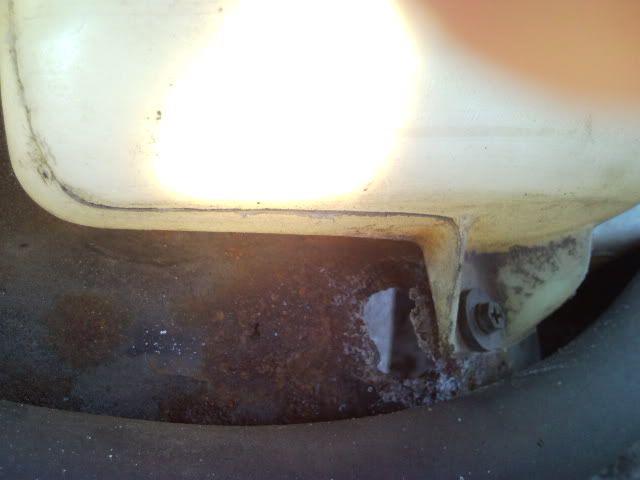 Mozilla/4.0 (compatible; MSIE 6.0; Windows CE; IEMobile 8.12; MSIEMobile 6.0) VZW:SCH-i910 PPC 240x400
|
|
#5
01-05-2010, 11:13 PM
|
||||
|
||||
|
Re: Rust Question
Quote:
Honestly? Throw the car away and start again. As a good general rule, for all the rust you can see, there is twice as much you can't. If the car has been used on salted roads, and is now showing lots of rust in lots of different areas, then it is beyond simple patched up repair jobs. The only way to fix it properly would be to completely strip it and bare metal the shell. Then have it acid dipped, then replace all the rusted metal, then rebuilt again.
__________________
Connecting the Auto Enthusiasts
|
|
#6
01-05-2010, 11:38 PM
|
|||
|
|||
|
Re: Rust Question
please say it isn't so. this is by no means a car that i'm making perfect. just look decent and run good. i hope there's an alternative to the above post.
Mozilla/4.0 (compatible; MSIE 6.0; Windows CE; IEMobile 8.12; MSIEMobile 6.0) VZW:SCH-i910 PPC 240x400
|
|
#7
01-06-2010, 06:32 AM
|
||||
|
||||
|
Re: Rust Question
Quote:
-Rod
|
|
#8
01-06-2010, 08:22 AM
|
|||
|
|||
|
Re: Rust Question
Quote:
|
|
#9
01-06-2010, 08:47 AM
|
|||
|
|||
|
Re: Rust Question
Quote:
|
|
#10
01-06-2010, 10:04 AM
|
|||
|
|||
|
Re: Rust Question
For all of us who enjoy working and learning about cars there is always one lesson that I believe every mechanic has to learn and that is: Cars don't last forever. No matter how much you put into it and fix it and keep it in good shape, eventually sometime down the road it will wind up as a pile of scrap metal. I have a 91 corolla that Ive had for 7 years and was the car I learned to drive on and since then have tried to make it "cool" but with the rust on it building up, I decided to halt that. The last thing I might do is make it a 6 speed and then drive it til it rusts to a bad point. Meanwhile, time to save money for something that can be ALOT of fun. Like say a nissan 300z or something that actually has some power and acceleration.
|
|
#11
01-06-2010, 10:53 AM
|
||||
|
||||
|
Re: Rust Question
Quote:
A grinder is far more likely to remove too much good metal and much more likely to either leave rust behind or result in holes though the metal. I have used both methods on rust like this many times. Sandblasting is far better, in every way. So, I think a blaster is better around the windows. The folds and bends in the metal mean this area is much less likely to warp, and make it far more difficult to clean up thoroughly with a grinder. But the rust on the flat pieces of metal, yes a grinder may be better there since they can be cleaned up thoroughly with a grinder, and misuse with a blaster may warp them. Also, you must use a liquid rust remover/converter on the clean metal area area before using bondo or paint. Failure to do so may (but not always) result in rust re-forming underneath the bondo. I have always used such a converter, with great results. But the 'professional' shop which fixed my 33 year-old Lincoln did not do so..... and rust is blooming underneath the Bondo. Also, using a rust converter-spray primer will not stop the rust on its own. Primer is not waterproof. A layer of grease will, especially if its renewed every couple of weeks (which will take 10 seconds of work) until the weather improves and the job can be done properly. That hole around the coolant recovery bottle is very easy to repair. Because it is not seen, a repair can be a bit rough-looking. Remove the recovery bottle, grind off the rust (the hole will get a bit bigger.) Use a rust converter, then paint the area with rust paint, then use some tin snips and cut a small patch piece out of some scrap sheet steel. (Some auto parts places sell metal to make patches). Then drill a couple of holes, so you can attach the patch with a couple of short sheet metal screws. Then drill a hole and reattach the bottle with the original screw. I cold do this job in about 30 minutes or so, no big deal. Finally, ignore the advice to start again. If the frame and floor are good then its a great set of wheels. These repair issues are pretty minor, imo.
|
|
#12
01-06-2010, 11:32 AM
|
||||
|
||||
|
Re: Rust Question
Point taken and duly noted. I was taking the poster's experience into account and sandblasters can be more damaging in the wrong hands. Of course so can grinders, but a grinder with rust removing wheel is easier to set up and use. Secondly, sandblasters are alot messier to cleanup than grinders, especially if you've got windows removed to allow the dust into the car. Finally, if the metal is as perforated as we suppose, it is no good structurally speaking...might as well remove it. But I agree if the rust is mainly on the surface or slightly penetrating, a sandblaster is best at removing rust w/o taking good metal with it. A choice of blasting material also helps to minimize warpage and creating a too-rough surface. More than 1/3 to 1/2 penetration of the metal thickness, I'd say grind it out.
__________________
Current Garage: 2009 Honda CR-V EX 2006 Mazda 3i 2004 Chevrolet Silverado 2500HD 2003 GMC Envoy XL 2000 Honda ST1100 2000 Pontiac Sunfire Vehicle History: 2003 Pontiac Vibe AWD - 1999 Acura Integra GS - 2004 4.7L Dakota Quad Cab 4x4 - 1996 GMC Jimmy 4wd - 1995 Chevrolet C2500 - 1992 Toyota Camry LE 2.2L - 1992 Chevrolet S10 Ext. Cab 4.3L - 1995 Honda ST1100 - 1980 Yamaha XS400 - 1980 Mercury Bobcat.
|
|
#13
01-07-2010, 08:34 AM
|
|||
|
|||
|
Re: Rust Question
is there a particular rust converter that you recommend?
|
|
#14
01-07-2010, 08:49 AM
|
||||
|
||||
|
Re: Rust Question
Quote:
The idea here, is even if you think you have bare, rust-free metal, inevitably there is some rust in the tiny nooks and crannies in the metal. And existing rust, even if its tiny, serves as a starting point for additional rust, so it all must be removed.
|
|
#15
01-08-2010, 01:03 PM
|
|||
|
|||
|
Re: Rust Question
so, i'm trying to gather the necessary equipment need for this. I've got the grease and rust paint. I've yet to find the recommended rust converter. The sandblasting tool would be a rental i suppose and would be in a few months. I'm looking for a grinder now and have a question about that. I was in the tool store and i saw two different tools which i suppose would be needed.
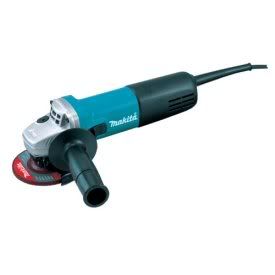 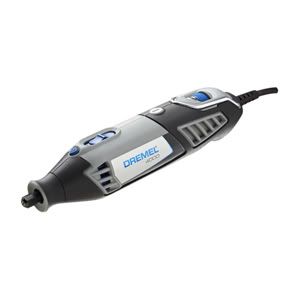 I think the bigger grinder is what's necessary for the body but will that be too big and cumbersome to do the work by the coolant tank with out messing up or taking off too much metal? Keep in mind this will be my first attempt at it so my hand won't be the steadiest. The rust removing wheel spoken of, is that a specific grit, wire brush, or it actually says "rust removing wheel?" I did not see it if so. With the temporary fix to prevent the rust from getting worse, i assume there will be black spots where the rust spots were from the rust converter being sprayed there? no biggie to me, just want to make sure what i end up with is what was expected. Also, a spot like this, 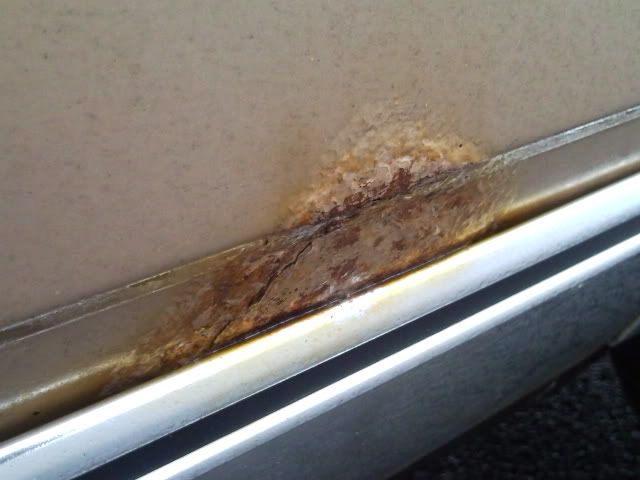 do I leave it as is and put something like the converter on top or take off the remianing flaking paint down to the rusted surface and then put the converter on it? The above link to the rust remover, that would be put on the clean metal prior to putting the bondo and finishing the actual fix, right? This is the rust converter i would use as the temporary solution, right? 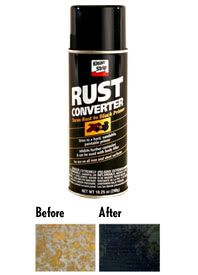 Lastly, before i put converter on anything, do i try to grind or sand down the rust at all or just leave it, throw the converter on (and grease every few weeks) and then address it the right way when the weather warms up a little? If it seems like any of these questions have been answered already, please forgive me. I've re-read the previous responses to get my answers but i would just like to clarify a few specific points. thank you
|
|
|
POST REPLY TO THIS THREAD |
 |
|
|









