

|
| Search | Car Forums | Gallery | Articles | Helper | Air Dried Fresh Beef Dog Food | IgorSushko.com | Corporate |
|
|||||||
 |
 Show Printable Version | Show Printable Version |  Subscribe to this Thread
|
|
|
Thread Tools |
|
#1
 09-16-2007, 01:29 PM
|
||||
|
||||
|
Valve Burning - any way to know BEFORE disaster strikes?
As anyone who has read my threads knows -
Back a year and a half ago, at 157,000 miles (?) on my used '93 Geo Metro with a 3 cylinder engine, the engine died. I did a compression check & found numbers 1 and 3 cylinders did not hold much pressure. Because many folks on this Forum talked me into it, I pulled the Head and found valve number one was burned thru on two sides.  I had the Head rebuilt for $225. 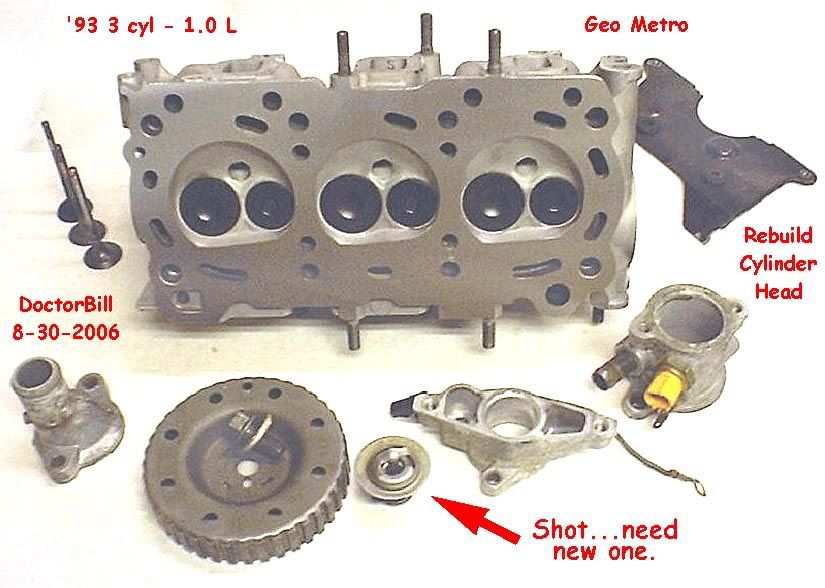 I was also convinced by these good folk to replace the Rings and Connecting Rod Bearings.   All that, step by step, was posted here with numerous photographs. I have now been driving the rebuilt engine in what I call "The Phoenix" since it arose from the ashes, as it were... But as I drive merrily around the countryside oblivious to all the gasoline stations, getting 49 miles per gallon and grinning at the "Hybrid Cars" that cost more than $20,000, I wonder whether or not I am burning up my "new valves" as I drive along....  Long story short - is there some way that I can check my valves for burning, now, short of pulling the Head off again? DoctorBill
__________________

|
|
#2
09-16-2007, 04:00 PM
|
|||
|
|||
|
Re: Valve Burning - any way to know BEFORE disaster strikes?
Doctor Bill,
Exhaust valves burn as a direct result of combustion that does not finish in the combustion chamber when both valves are closed. They overheat (melt, break, deform) when the ignited fuel charge continues after the exhaust valve opens, burning the face and causing said deformations. High combustion temperatures can aggrivate this (lean fuel mixture). Retarded ignition timing (a spark which occurs too late in the combustion cycle) can directly result in burned exhaust valves. An inoperative EGR system can directly result in burned valves (and in these cars is often THE reason why the valves burned) as well as burned pistons/rings/head damage etc. If you keep your car well maintained you will avoid burning the valves. When you change a timing belt, make sure it is properly installed and the sprockets are properly aligned. When you set your ignition timing, make sure it is at least 5°BTDC. Keep your plugs wires cap and rotor in good repair. Keep the O2 sensor before the cat in good repair. And by all means, be sure that your EGR system is functioning properly. Also, keep your exhaust system in good condition. Exhaust restrictions that have not advanced far enough to contaminate the A/F charge in such a way as to seriously impede performance, will still raise temperatures at the exhaust valves, and may compound other contributing factors. In other words, with all the systems working properly in a well maintained vehicle, exhaust valves willn't burn. -MechanicMatt
__________________
1996 Caprice 9c1 - Daily Driven Project Car 1993 Geo Metro - Accident 1991 Caprice 9c1 - Destroyed 
|
|
#3
09-17-2007, 05:41 PM
|
||||
|
||||
|
Re: Valve Burning - any way to know before disaster strikes?
Matt has hit on most of it, I'd add make sure you use 5W-30 oil and don't run it at high speeds for long periods. No more than 70 mph for a manual and certainly no more than 65 for an auto. High rpms are particularly hard on the valves. Advancing the ignition timing will reduce it and give you better mileage, and stainless steel valves are much tougher than regular steel. Basically though, if you're driving it, you're burning the valves.
|
|
#4
09-17-2007, 06:16 PM
|
||||
|
||||
|
Re: Valve Burning - any way to know before disaster strikes?
1. I hope the EGR System is not all "Carboned Up" now like it was when I replaced the head and rings....
2. I want to check the plugs (has about 15,000 on them now) soon. 3. I'll check the timing when I check the plugs. 4. $250 to have the Head Rebuilt is not bad at all if I get 100,000 miles out of these valves before they get burned up... 5. I hope the Rings don't go T.U. during that 100,000 miles ! I see so many Geo Metros around now - one this morning was BEAUTIFUL ! There are quite a few guys I meet at the COSTCO gas pumps with Geo Metros who say hello and we get to talking and they LOVE their Metros! I often offer to buy their Metro, but they yell, "Hell no! I love this car!" 50 mpg is sooooo nice! DoctorBill
__________________
|
|
#5
09-19-2007, 07:44 PM
|
||||
|
||||
|
Re: Valve Burning - any way to know before disaster strikes?
Doc,
Some time ago (years?) you posted a tidbit about cleaning the EGR passageway with a brush. It involved removing the header every so often and then snaking the tunnel going to the throttle body. I tucked this away as being a great idea and have planned on using it perhaps once a year as a routine. This should alleviate any valve burning problems. If you could re-post it, it might save some folks a lot of headaches, Thanks for your insight. DL
|
|
#6
09-20-2007, 07:09 AM
|
|||
|
|||
|
Re: Valve Burning - any way to know before disaster strikes?
It's easy to test to see if the EGR system is clogged. Start the engine and let it idle. Apply vacuum to the EGR valve and see if the idle drops. If it doesn't, it's clogged.
Q
|
|
#7
09-20-2007, 07:33 AM
|
||||
|
||||
|
Re: Valve Burning - any way to know before disaster strikes?
DavidLang - Have a look at the recent "Help high idle after I rebuilt engine??" thread.
Hugemoth - How would I go about applying vacuum to the EGR valve? Where? Haven't worked on The Phoenix for quite a while now. I need to pull out my Speedometer Cable - never did get it back in correctly so now the Speedometer jumps and falls. I hope the end of it in the Transmission isn't screwed up or worn to a nub. That was hard to get connected up correctly and the clip didn't want to set in the slot correctly. I guess I never did it right. DoctorBill
__________________
|
|
#8
09-20-2007, 07:40 AM
|
|||
|
|||
|
Re: Valve Burning - any way to know before disaster strikes?
Easiest way if you don't have a vacuum pump ($20 at Harbor Freight) would be to pull the vacuum hose off your cruise control and plug it on to the EGR valve. Plug it on to the small connector. You'll be able to see the diaphragm move and at the point the engine idle should slow significantly.
Q
|
|
#10
09-24-2007, 03:25 AM
|
|||
|
|||
|
Re: Valve Burning - any way to know before disaster strikes?
Yeah vacuum leaks can't be good for valves - good insight. Also, you sould be able to kill the engine entirely in short order by manually opening the EGR valve at idle - if the engine doesn't stumble out and die immediately (10 seconds MAX) there is definitely a restriction in the system. I just use two fingers on the diaphram, on opposing sides to open the valve. Becareful though, it does get hot.
-MechanicMatt
__________________
1996 Caprice 9c1 - Daily Driven Project Car 1993 Geo Metro - Accident 1991 Caprice 9c1 - Destroyed
|
|
#11
09-24-2007, 06:55 AM
|
|||
|
|||
|
Re: Valve Burning - any way to know before disaster strikes?
Why would a vacuum leak cause burned valves? Shouldn't the computer add enough fuel to keep the mixture correct? The result should be just a fast idle.
Q Quote:
|
|
#12
09-24-2007, 05:06 PM
|
|||
|
|||
|
Re: Valve Burning - any way to know before disaster strikes?
Quote:
However, in systems which incorporate a MAF sensor, a vacuum leak introduces "unmetered" air into the engine which causes a lean condition, which raises combustion temperatures, which is not good for the exhaust valves. I think thats where mx was coming from. As far as any metro I've come across (including those late 4-cyl with waste spark ignition and MPFI) we are all driving speed density systems. So a vacuum leak in our cars wont nessecarily result in a lean condition. Speed density uses (primarily) the MAP sensor, engine RPM and O2 readings (and secondarily, ECT, IAT etc..) to calculate engine load. Hence the name speed (engine) density (manifold absolute pressure). If the computer sees a massive vacuum leak (high pressure - open throttle) and low engine speed along with a lot of excess oxygen in the exhaust stream, it seems natural that it will add fuel (artificially climbing a hill) which as you stated would cause a mere high idle. -MechanicMatt
__________________
1996 Caprice 9c1 - Daily Driven Project Car 1993 Geo Metro - Accident 1991 Caprice 9c1 - Destroyed
|
|
#13
09-24-2007, 06:10 PM
|
||||
|
||||
|
Re: Valve Burning - any way to know before disaster strikes?
Let's see if I understand this then...with a Geo metro (mine is a '93 3 cyl) the
ECM will sense a vacuum leak and compensate by adding more fuel to the air mixture. Won't that start to Carbon Up the Engine? Won't your miles/gallon fall drastically and you'll lose POWER....? Did I get that right? In any case a Vacuum leak is a baaaad thing! YES? If I remember correctly from rebuilding my engine (Head and Rings), when I reassembled all the hoses, there are essentially two (2) vacuum lines. One comes from the front of the TB and one comes from the back end of the TB. If one has a vacuum leak somewhere - would a Vacuum Gauge on the dashboard be a good thing to monitor for a leak? If so, would it be bad to tie the gauge to both vacuum hoses via a "T" connector? Or should one have separate gauges for the front and back TB hose barbs? What I am thinking is that by having a Vacuum Gauge as an after market dashboard gauge, one could see when a leak develops instead of finding out later by having one's valves burn up. If the Vacuum Gauge reads low of a sudden - immediately check for leaks with a Butane hose device and FIX IT ! Does this make any sense?! A Butane Torch Set-Up for detecting Vacuum Leaks....makes engine rev up when the Butane gets near the leak point !  DoctorBill PS - What Vacuum values should a well running engine be exhibiting on a gauge?
__________________
Last edited by DOCTORBILL; 09-24-2007 at 06:46 PM.
|
|
#14
09-25-2007, 03:01 AM
|
|||||
|
|||||
|
Re: Valve Burning - any way to know before disaster strikes?
Quote:
Quote:
Quote:
Now suppose you have a vacuum leak at the intake manifold gasket at the #2 cylinder. The o2 sensors will pick up the high oxygen content, broaden out the pulse width and adding more fuel until it finds the oxygen content acceptable. But remember, the ECM cannot give more fuel to one cylinder than the others, so the added fuel is divded by the 3 cylinders. 2 cylinders will run richer than the leaky one, and sense the added fuel is in proportion to the leak, it will only compensate for the lean cylinder by 1/3. So that #2 cylinder will still be lean. So it really depends WHERE the vacuum leak is occuring. This condition if left uncheck has the potential to cause excess carbon build up in the cylinders that are not experiencing an isolated vacuum leak. Quote:
Quote:
-MechanicMatt PS sorry for the long responses - but you're diggin it out of me  Too much time on my hands? Noooo... Too much time on my hands? Noooo...
__________________
1996 Caprice 9c1 - Daily Driven Project Car 1993 Geo Metro - Accident 1991 Caprice 9c1 - Destroyed
|
|
#15
09-25-2007, 08:12 AM
|
||||
|
||||
|
Re: Valve Burning - any way to know before disaster strikes?
"Many guys actually do this - and it's cool to watch the gauge react to throttle position.
This is a good way to monitor for a leak. You only need one direct, unimpeded source of "manifold" vacuum - its the same no matter where you get it from. Are you positive about that? I thought I saw a difference when I was farting around obtaining a vacuum source for my Cruise Control....front versus back barbs of the TB. Front barbs gave higher vacuum and at different positions of the throttle than the back barb gave. FRONT Barbs - Zero full throttle - 26 PSI during deceleration - connected to EGR Valve BACK Barb - 8 PSI during acceleration - 18 during deceleration - connected to MAP (If I remember correctly...) 18-22in. hg. at idle is the widely accepted figure. And 0 at wide open throttle" That's what I wanted to know! So a Dashboard Vacuum Gauge is useful along with monitoring the miles per gallon to keep an eye out for vacuum leaks - which burn up the valves. ALSO - my "green arrow" - the CHANGE GEARS light is caused by vacuum - is it not (or is it run by the ECM?). My "green arrow" lights up a lot when I stay in 4th going up hills. That is showing that I am pulling a strong vacuum - isn't it? "sorry for the long responses - but you're diggin it out of me" - That's my job! It is why I annoy people so often..... DoctorBill
__________________
Last edited by DOCTORBILL; 09-25-2007 at 09:49 AM.
|
|
|
POST REPLY TO THIS THREAD |
 |
|
|








