

|
| Search | Car Forums | Gallery | Articles | Helper | Air Dried Beef Dog Food | IgorSushko.com | Corporate |
|
#1
 05-10-2007, 07:15 PM
|
|||
|
|||
|
Anyone experience with rust repair.
Well I've got a doozy.
I'll show you the problem. Need some suggestions. I think this will need to be addressed but I'm not sure where to start. 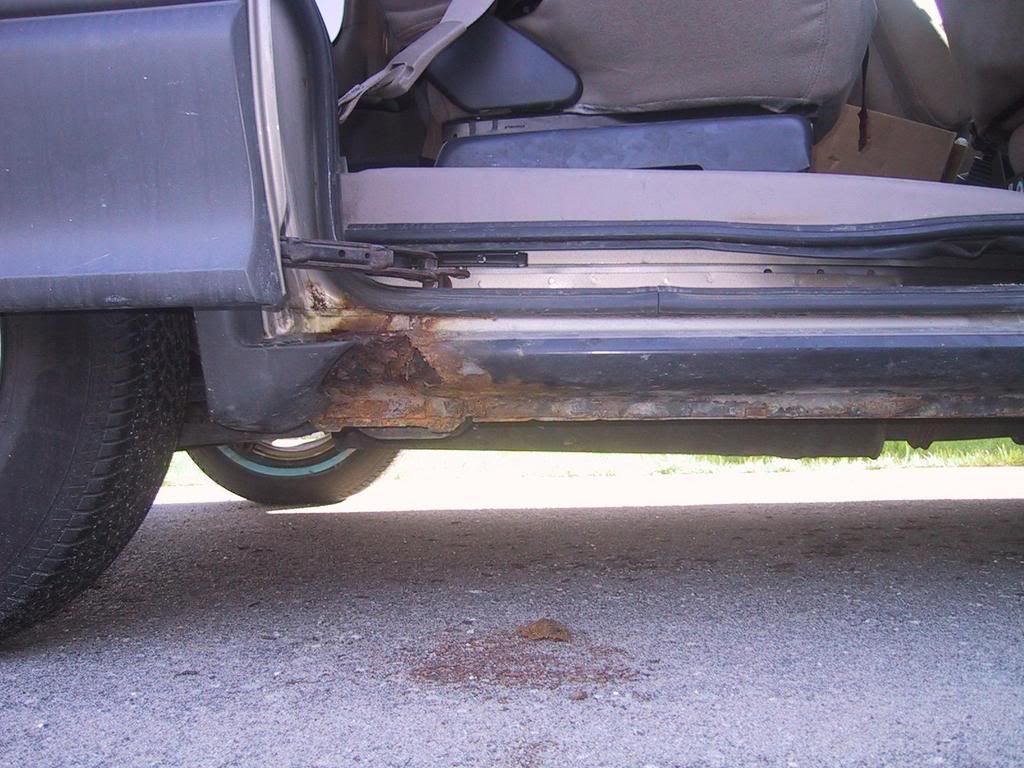 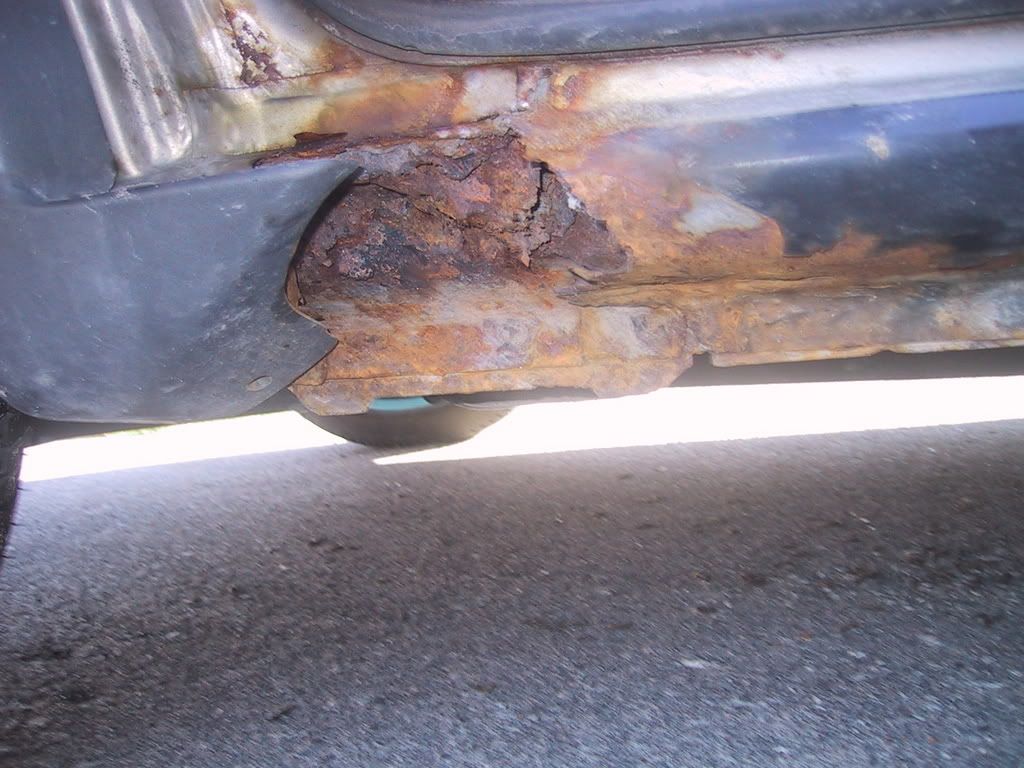 There is a long story to how they got that way. I found out after it started to rust that a while back I had my van in to get repaired after a car accident (minor one... but enough to need the sliding door and lower mold replaced) While there they improperly lifted the van.. I guess they had the lift arms in the wrong place and it crunched this area in. I didn't notice it until it was bad. Now I'm stuck with this.. on both sides. Any suggestions. Thanks 
|
|
#2
05-10-2007, 07:58 PM
|
|||
|
|||
|
Re: Anyone experience with rust repair.
New rocker outer panels and fabricate and repair inners, is the only right way here. Run into this in my shop in upstate NY all the time. Done right about 800.00.
__________________
|
|
#3
05-10-2007, 08:15 PM
|
||||
|
||||
|
Re: Anyone experience with rust repair.
That's where mine started before it spread and overtook the whole rocker panels on both sides. Ah the joys of road salt
 I am starting to see a lot of this on the GM minivans of the late '90s. You still can get the replacement rockers from GM. If you can get your hands on a collision repair parts book, which many auto body shops use, you can get the part #s. I have seen pages from these books sold on eBay for each respective model of vehicle. I bought one for my van as a handy reference "minimanual" of parts breakdown and GM part numbers. I decided not to repair the damage on my rockers on my Venture. I ended up buying a 2006 Uplander last Fall and the first thing I did was have it undercoated and rustproofed in hopes of avoiding that problem with this vehicle. I am starting to see a lot of this on the GM minivans of the late '90s. You still can get the replacement rockers from GM. If you can get your hands on a collision repair parts book, which many auto body shops use, you can get the part #s. I have seen pages from these books sold on eBay for each respective model of vehicle. I bought one for my van as a handy reference "minimanual" of parts breakdown and GM part numbers. I decided not to repair the damage on my rockers on my Venture. I ended up buying a 2006 Uplander last Fall and the first thing I did was have it undercoated and rustproofed in hopes of avoiding that problem with this vehicle.
__________________
Thought for the Day… Alcohol does not make you fat - It makes you lean... against tables, chairs, floors, walls and ugly people.  If a prostitute here in America loses her job to a prostitute in India , is that considered "outwhoring"??-Jay Leno
|
|
#4
05-10-2007, 09:18 PM
|
|||
|
|||
|
Re: Anyone experience with rust repair.
This is definately going to be a job involving some swearing and time.
I'm going to try and get it cleaned up enough to evaluate what needs to be done. The fabricating part is likely going to kill me. My only experience doing body work was fixing lower units in boat motors at a marina when I was teenager... oh boy. I'm curious if anyone has documented this type of job. I looked for that collision repair manual but so far I haven't had much luck. A couple questions? The outer rocker is welded right to the inner right? So would I need to cut and just add or remove the entire thing and replace it? and with fabricating I'd use a standard piece of sheet metal and then make my replacement piece, weld clean prep and paint? I think I'll likely have to remove the trim, sliding door and weather guard. PS if you can find a link for that repair manual lmk. Thanks for the info. I've got a week or so to research this before I start working on it... although I think I'm going to clean it up to see what is what. I'll take more pictures when that is done. First thing I'm going to do when I get this done is get a good undercoating.. I see the error of my ways.
|
|
#5
05-11-2007, 02:05 PM
|
||||
|
||||
 Re: Anyone experience with rust repair.
Quote:
 The moisture gets trapped behind the metal where the two panels meet and over lap. Used to be they used a sealer between the two panels being joined and burned right through with the spot welder during assembly. Finishing with a seam sealer on the outside before painting. Do I hear cheaper is better! Anyway, yes the rocker is attached to the inner with spot welds. You can drill them out (you don't even have to drill right through, just enough to weaken the weld) then split the inner and outer rocker apart with a small cold chisel. It's reasonably easily to do, just make sure you clean everything up with a wire brush inside and out, AND seal everything up when you are done to prevent more water from getting in. I'd coat the inside of the rocker with some type of rust paint (I use RustStop from Canadian Tire) or failing that, some type of sealer for as far as you can see or reach before re-assembly. I haven't tried it but I think you can still get zinc oxide in an aerosol; - an effective deterrent to rust in areas you can't see like the inside of a rocker. Try to keep the sealer way from the places where you want to place welds. And by all means use a MIG welder, as brazing has not been allowed on vehicles since the mid 1970's. - NO POP RIVETS EITHER.Fit the repair metal piece (the thinnest I'd use is 20 gauge mild steel sheet - but 18 gauge would likely be better) into the opening (butt it to the old rocker to fill the hole; - this will take you considerable time to get it to fit just right, but the benefits of taking your time here will pay off when it comes time to weld). DO NOT overlap the repair as this will not give you as strong a weld or as pleasing a result. Remember, the rocker is a structural part of the van's unibody; - without it you have the beginnings of a limp fish. Grind everything down smooth with an 80 grit disk designed for this purpose and apply waterproof filler to smooth it out. Don't use regular Bondo as it is porous and attracts water like a sponge. Sand, prime and paint...if your van is like ours you should be able to use 'silver-mist metallic' and just about any black-mat finish automotive touch-up paint to cover.Good luck...save us a picture of the 'after' result, OK? Last edited by 1999montana; 05-12-2007 at 10:43 PM.
|
|
#6
05-11-2007, 07:49 PM
|
|||
|
|||
|
Re: Anyone experience with rust repair.
As soon as I get it cleaned up a bit and see exactly what the damage is under it all, I'm going to outline a game plan... I'll post some pics up in a few days. I've got to head down to my local princess auto to pick up some wire brushes, sanding supplies, and everything else I need.
I hadn't even thought about the paint. Will Canadian Tire have the stuff I need. Where can I find my paint colour from? I send and received an email from GM regarding the collision repair manual. They referred me to a company called [FONT='Calibri','sans-serif']Helm Incorporated at - 1-800-782-4356. They said I can get all the service manuals through them and they also refered me to a vintage company http://www.kenmcgeeautobooks.com/ for a variety of research related things. Quote:
[/font]
|
|
#7
05-12-2007, 11:09 AM
|
||||
|
||||
|
Re: Anyone experience with rust repair.
Quote:
I think there are two places on the van that have the color codes, one on the driver's door edge and if you have the auxilary power and air inflator kit, on the inside of the removable door at the left rear of the inside of the van. GM outsourced all of their shop manuals to Helm a few years ago, although you used to be able to buy them direct from GM's Publications Services several years back. Not sure I would invest the dollars unless a) you feel more comfortable using them as reference, or b) you plan to keep the van a good long time. Last edited by 1999montana; 05-12-2007 at 10:38 PM.
|
|
#8
05-12-2007, 10:38 PM
|
||||
|
||||
|
Re: Anyone experience with rust repair.
Quote:
__________________
Thought for the Day… Alcohol does not make you fat - It makes you lean... against tables, chairs, floors, walls and ugly people. If a prostitute here in America loses her job to a prostitute in India , is that considered "outwhoring"??-Jay Leno
|
|
#9
05-12-2007, 11:01 PM
|
||||
|
||||
|
Re: Anyone experience with rust repair.
Warlock,
Looking closer at the second picture it looks to me like most of the inner rocker is rotting as well. What does it look like from under the van looking out toward the rocker? You may have to cut a lot of metal out to get back to good solid steel. My guess is that you will likely need to cut at least 12 inches (moving forward) and you may end up replacing both the inner and outer sheet metal to do it right. Here's an image of a project I started about 12 years ago. The vehicle is a 78 Dodge, a western car until 1985 when we moved here. It was only on the salt roads of Ontario for 6 years before the rust damage became severe enough to bring me to the point of 'kick or play'....I'm still playing as you can see! 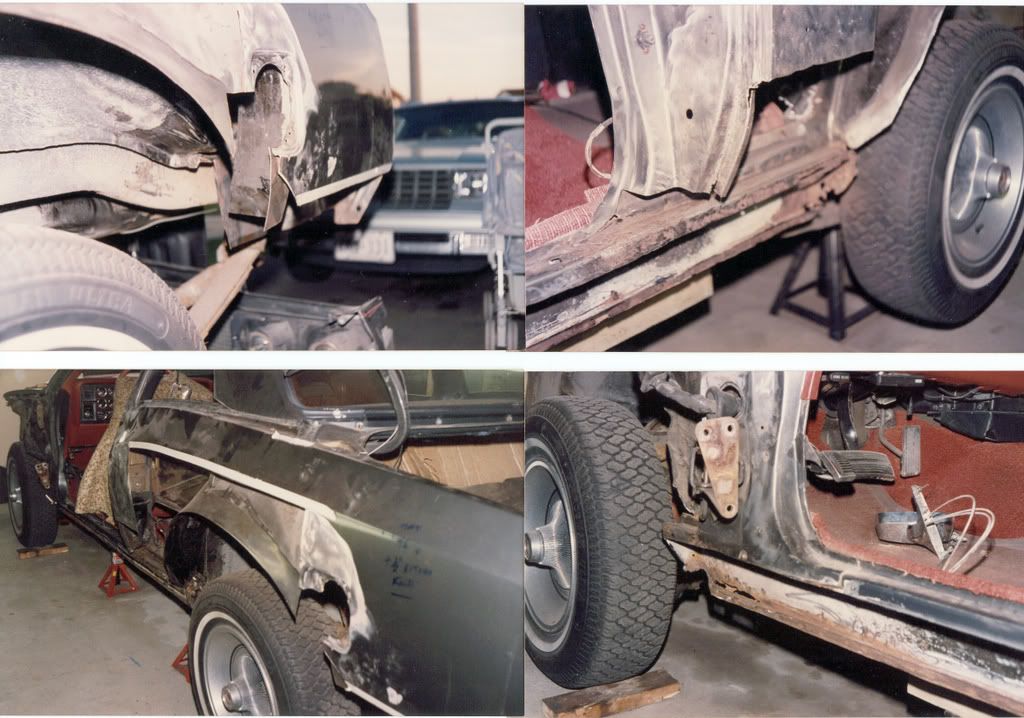 The rocker is the area that will catch your interest and attention. What you are looking at is the inside of the rocker with the outer panel removed. This rust damage is the result of two things: a) a body shop repair done badly in 1981 that caused a small amount of water to enter from above in the quarter panel just ahead of the rear wheel. The hole was only an 1/8", but it allowed water in every time it rained or the car was washed. b) road salt damage on an unprotected unibody. Last edited by 1999montana; 05-29-2007 at 07:51 PM.
|
|
#10
05-21-2007, 11:32 PM
|
|||
|
|||
|
Re: Anyone experience with rust repair.
I've been busy researching HOW to actually do this job.
Believe it or not I'm finding it hard to locate information. I'll take some pictures from both sides tomorrow and post up. I had the car repaired once in that area when another car hit the side of it and I would be inclined to blame that except for the fact that both sides are rusting in the same spot. I suspect something happened on a hoist or just plain and simple problem. Maybe I can get some suggestions. I've got a gas mig using argon/co2 so I'm confident I'll be ok to do that. I'm not sure how exactly to remove the outer rocker. I don't see any spot welds. It looks like its intact the entire length. I also couldn't find any parts (IE rocker etc) so I will likely be manufacturing all the parts. Found a local supplier for sheet metal. (I think its 20 gauge) I'm wondering what I should use to cut out the rusty parts, and further clean up the weld, smooth out to prep for painting. Any experience here to help me out. The space is cramped and my experience is limited on available tools these days. I'll post more pics tomorrow. Cheers
|
|
#11
05-22-2007, 10:34 AM
|
||||
|
||||
|
Re: Anyone experience with rust repair.
Quote:
Don't know if you mean the space you will work in is cramped, or the repair area is cramped, but I would definitely jack the van up and support it with axle stands, one side at a time. Remove all of the outer trim in the area of the repair (the Montana lower panels; - pretty sure they are attached with plastic clips behind, but a trip to the dealer parts counter and an electronic parts catalogue viewer will tell you more). The MIG you have (inert gas welder) is a good one. I have a flux core / two heat setting one that suits me, but wish I had the former. As for tools, simple hand tools will remove some/most of the metal/rust. CTC had aviation snips on sale earlier this year; - they may do so again (usually come as a right, left and straight cut threesome). Princess Auto may also have them at reasonable prices. (They will have other uses too; - you can use them to cut vinyl too should you decide to do some siding on your house or build a shed for instance). Oh, and you can't have enough vise grips to hold things in place either; - 3 to 4 pair are a must. A small electric jig saw with a fine metal cutting blade works well. Make sure you have at least 3 to 6 extra blades though as you will often break one when it hits a hidden object behind the facing rocker panel!) Move slowly at low spead and you should be able to make reasonable straight cuts. You can use a small wooden block under the saw between the rocker and the saw to shorten the stroke of the blade thus preventing broken blades to some extent. Air compressors and air tools are a boon when working around bodywork as you can blow dust away to see exactly what you're working on. (Use a mask and eye protection). Remember though that air tools take a lot of air, so if you don't have a compressor make sure you get one that will deliver at least 4 CFM at 90 lb pressure. I have a 3 hp 220 volt with a 30 gallon tank. (NO, you can't borrow it!) This can also allow you to use an air nibbler or air powered shear to remove the sheet metal. Of the two, I'd opt for the nibbler because the other is just a lazy man's way of using a simple hand tool. A small air powered dual orbiting sander is good for smoothing the finishing bodywork up. I also use an inline/reciprocating sander (about 20" long) to smooth out long stretches and make them almost perfectly flat. You can use a variable speed drill with an arbor designed to hold a sanding disk to clean up adjoining metal. If you are simply cleaning sheet metal don't use anything less than 80 grit or you could burn through or remove too much metal. I find a brass bristle wire brush (as opposed to a standard steel wire brush) in a drill or high speed grinder works well to remove rust without burnishing the steel so that you can see how clean it really is. The inner rocker is likely 18 gauge steel. the outer may be also, but using 20 gauge won't hurt, and the thinner metal is easier to work with too. The only place you may see spot welds will be on the bottom of the rocker where the inner and out panel join. The top is likely buried inside the van, but essentially the two panels will be joined with spot welds that are usually not much bigger that 3/16" in diameter spaced about 1 and 1/2" apart. I doubt that GM applied much effort to hide them during assembly. Don't worry about removing the entire outer panel as long as you can get back to good, clean rust free metal. Looks to me like the top outer is reasonably clean of rust, but you will have to work at it to get back to a good clean start. I'd expect to see a hole about 4 times bigger than your camera picked up once you have cut, ground, cursed and cleaned up the surrounding metal. Keep the larger pieces you cut out to have an understanding of how the panel looked before you started cutting. Make templates where appropriate using stiff paper (shirt cardboard or cereal box) of regular cardboard. Transfer the template to the sheet metal and cut the piece at least a 1/4" BIGGER on all sides (it's that 'you can always cut it smaller, but you can't cut it bigger' thing you want to avoid) so that you can custom fit the piece to the opening for a snug fit. A bench vise, some basic body tools/hammers and a big hammer will come in handy to create a crease in a piece of steel sheet (like the bottom of the rocker where it will join with the inner panel). Try to keep the curve of the rocker as much a possible. Your objective is to replicate the sheet metal so that you will end up using very little WATER PROOF bondo to clean it up. The welds can be cleaned with an 80 grit disk. There are special grinding disks (look similar to Dremel discs) that you can add to a drill or air tool to grind the welds smooth too. Just don't remove too much of the weld or it will weaken. You've got a challenge on your hands, (I'd rate it about a 6 out of 10) but I think you will find if you start slowly, don't rush it and study what your have once cleaned up, you'll come away learning something new and be able to apply it elsewhere later on. If I were doing this type of repair, I'd expect the van to be off the road an entire weekend to get it to a point where you could spot paint the repairs, but I am fussy too. If you take your time, you will end up with a repair that most would never notice. Last edited by 1999montana; 05-27-2007 at 02:20 PM.
|
|
#12
05-22-2007, 02:01 PM
|
|||
|
|||
|
Re: Anyone experience with rust repair.
Thanks for the information.. it has been most helpfull. This site rocks by the way... I'm a born again DIYer and this is better than my old shop class days. Much more knowledge to draw on.
I have a compressor with a 20 gallon tank.. I think it runs 5.7 at 90 or something close to that. I use it for my woodshop.. . I hadn't even thought of that for this... I may have to go looking at tools... (insert Dr.evil laugh here) I found a place here in Barrie TSS autobody supply that can get an outer rocker for me $30 cdn. So that will save me some work. I'm just going out now to fix up a new muffler and I'm going to clean up the rusted area a bit. I'll post up updated pics when I get back later
|
|
#13
05-22-2007, 07:39 PM
|
||||
|
||||
|
Re: Anyone experience with rust repair.
Warlock,
This is a handy tool for punching the spot weld holes in the panel you will attach. It will punch out a 3/16 hole in the bottom flange of the rocker. Place your MIG wire in the mild of the hole and fill it in making sure you make good contact with the inner rocker panel: 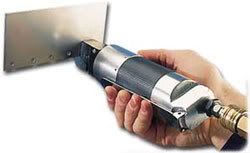 (It has two sets of jaws, one for punching and one for flanging to allow over-lapping two pieces of sheet metal. But as I mentioned previously, it does not give you the same strength that a butt-weld will. Can be useful to replace a piece of steel in the field of a fender or quarter panel though.) Last edited by 1999montana; 05-29-2007 at 07:52 PM.
|
|
#14
05-23-2007, 09:30 AM
|
|||
|
|||
|
Re: Anyone experience with rust repair.
OK I took some more pics yesterday. Now that the muffler is out of the way I can focus on this job. These pictures are of the passenger side. Which is the worse of the two.
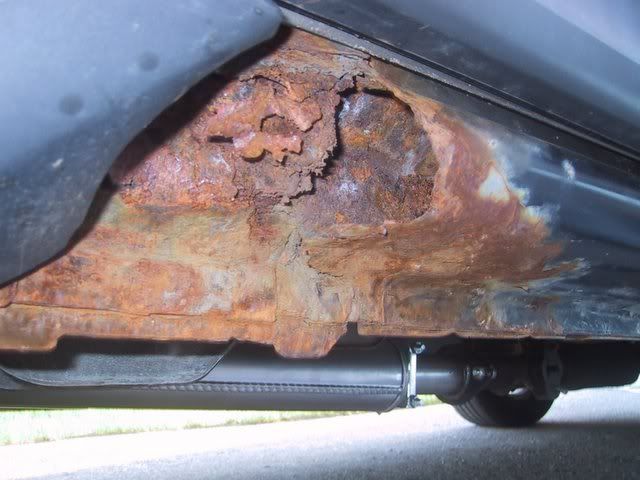 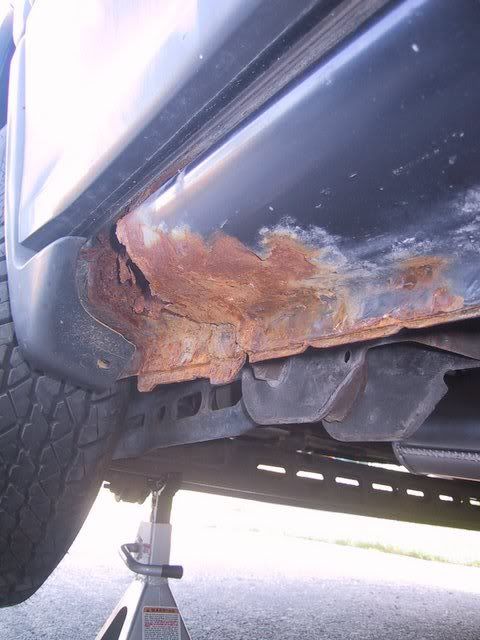 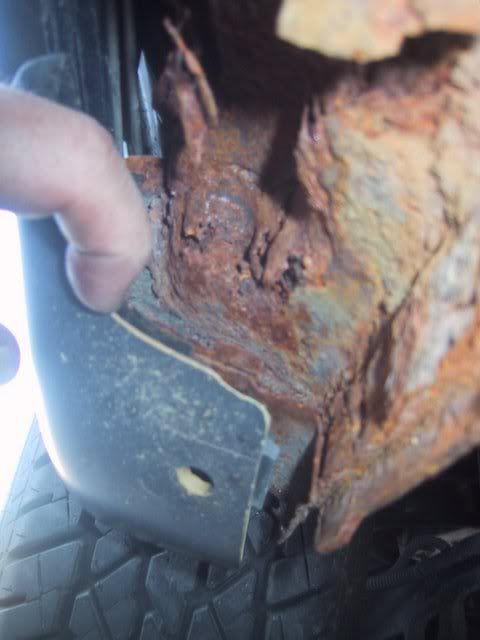 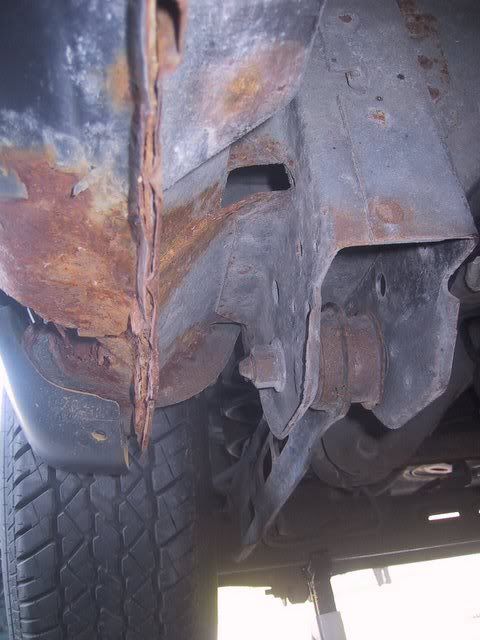 Most of the inside stuff is surface only. There is some kind of cloth material on the inside of the rocker. Not exactly sure what it is or why its there. I pick up the replacement rocker this afternoon. My question is... and I doubt it will hurt but is there any reason why I couldn't clean up the area now pull away dirt to clean metal and just prime until I can sit down to do the actual job. It is likely to be a few weeks before I can dedicate the time. I'm not going to cut any metal out just clean off the rust and clear the area of debris
|
|
#15
05-23-2007, 09:49 AM
|
||||
|
||||
|
Re: Anyone experience with rust repair.
Warlock,
Those are incredible pictures. You must live next door to a salt mine (small attempt at humor!). I'd clean some of it up and put some type of rust inhibitor (Rust Stop or similar; - you want something that will turn the surrounding rust inert) and create a surface that can be sanded or primed, (but that doesn't mean you can leave the rusty metal there). It will slow it down though. A few more weeks will not make that much difference. The damage has already been done. Looking at the pics, the inner rocker should clean up reasonably well with plenty of wire brushing (high speed grinder with a wheel; - CTC has a grinder on sale this week, I think). Those 'pinches' in the bottom of the rocker are where the welds are. The holes on either side of the pinch are designed to drain the water that finds its way in. If there is cloth in there, it could only get there two ways; - during manufacture, (the old pop can in the closed panel thing the guys on the line used to do to drive folks nuts!), or it was placed there to hold something in place (bondo?) by the shop that repaired the damage you mentioned. Either way, the cloth material would hold water and consequently rust everything it touched. Nice new shiny muffler, by the way! Last edited by 1999montana; 05-27-2007 at 02:22 PM.
|
|
 |
POST REPLY TO THIS THREAD |
 |
|
|






