

|
| Search | Car Forums | Gallery | Articles | Helper | Air Dried Fresh Beef Dog Food | IgorSushko.com | Corporate |
|
|||||||
| Tips and Maintenance Post helpful tips, maintenance guides and R&R procedures here |
 |
 Show Printable Version | Show Printable Version |  Subscribe to this Thread
|
|
|
Thread Tools |
|
#1
 01-07-2007, 11:12 PM
|
||||
|
||||
 Coolant Temp Sensor on 99+ Grand Am Testing
This works on 99'+ N-Bodies,
but is relevant to most N body temp sensors vs. resistance values. Heres a pic of the coolant temp sensor, and it located right under the TB on the V6(3.1 & 3.4L) easy to see and get to. Easy to locate on the 4cyl(2.4L) too. V6 temp sensor 4 Cyl Temp sensor Testing your Coolant temp sensor is as follows; - First inspect the wires at the plug for looseness or breaks. - Now test the circuit for power from the PCM. - Disconnect the plug-in on the sensor and test the two terminals on the wire harness. - Connect the + lead on the voltmeter to #1 and the ground to #2. - Turn the key on, should read approx 5 volts. - If not check the wiring from the plug to the pcm. - If the cicuits are good have the PCM checked by a dealership or other qualified shop. Checking the resistance values 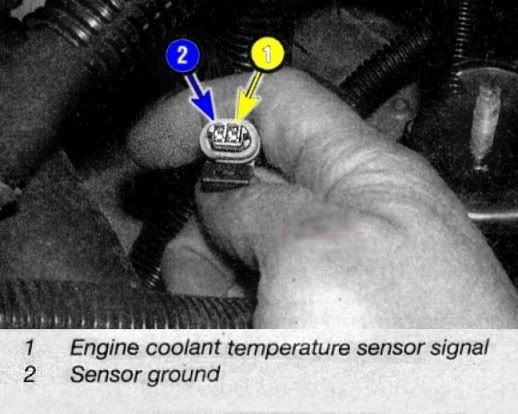 - With the ignition off and engine cold, unplug the sensor connector. - Using an Ohmmeter measure the resistance between the terminals on the sensor cold(between 50-80 deg). Write that # down. - Start the engine and let it get to running temp between 180-200deg. - Disconnect the connector and test the resistance again. - Compare the two measurments to the chart below. 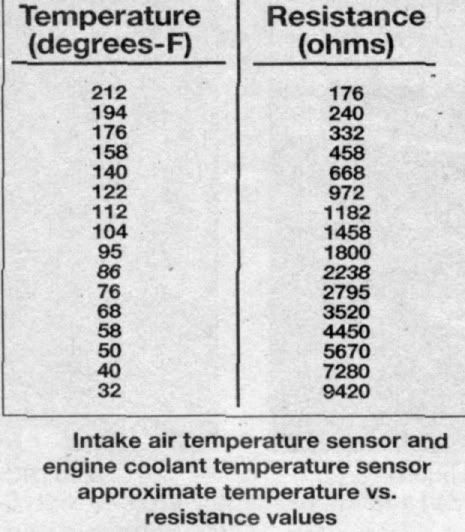 - If the results are incorrect then replace the sensor. - When replacing the sensor use teflon tape to seal from leaks. Hope that helps. 
__________________
1999 Grand Am SS 3.4 OHV 
Last edited by xeroinfinity; 01-15-2007 at 09:37 PM. |
| The Following User Says Thank You to xeroinfinity For This Useful Post: | ||
jerryhunt92284 (07-19-2011)
| ||
|
|
POST REPLY TO THIS THREAD |
 |
|
|





