

|
| Search | Car Forums | Gallery | Articles | Helper | Air Dried Fresh Beef Dog Food | IgorSushko.com | Corporate |
|
|||||||
| Forced Induction Discuss topics relating to turbochargers, superchargers, and nitrous oxide systems. |
 |
 Show Printable Version | Show Printable Version |  Subscribe to this Thread
|
|
|
Thread Tools |
|
#1
 01-05-2005, 01:05 PM
|
|||
|
|||
|
Effect of intercooler pipe diameter on performance?
While it's obvious that too small a pipe will choke performance, I'm curious about the other side ofht ecoin: How does an intercooler pipe size that may be too large affect performance?
I'm currently running a smallish FMIC with 3" piping on my Toyota 22RTE truck: 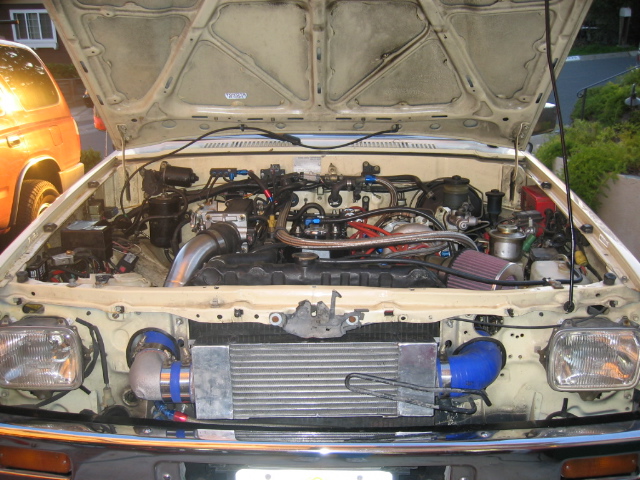 The system works OK, but I believe I can do better. I recently picked up an intercooler that should offer better cooling and flow due to a larger frontal area and a more flow-friendly design, however, the new IC has 2.5" inlet/outlet piping. My question is, what effects can I expect from downsizing from 3" to 2.5" piping? Will the greater velocity from the smaller size improve response, or will the smaller piping choke flow at WOT? I'm currently making 220 rwhp @ 15 psi (91 octane gas, no water injection), so the current 3" setup is probably oversized for my needs. However, I will be adding WI in the near future and hope to be able to run a leaner mixture and more boost (the motor is built for a solid 300 rwhp)...but 3" may still be too large for my motor, and i wouldn't mind tuning the system a bit for better low end response. And if I'm going to move to the new intercooler, I'd just as soon do it when I'm plumbing the WI... Thanks for whatever feedback you can provide. -Jeff
__________________
-=-=-=-=-=-=-=-=-=-=-=-=-=-=-=-=-=-=-=-=-=-=-=-=-=-=-=-=- 1986 Toyota 22RTE 4x4, 222 rwhp on pump gas: http://www.well.com/user/mosk  
Last edited by mosk; 01-05-2005 at 03:45 PM. 
|
|
#2
01-05-2005, 03:17 PM
|
|||
|
|||
|
Re: Effect of intercooler pipe diameter on performance?
im just curious as to why you would want to run leaner when you run more boost even with water injection. sorry i cant help with you question though.
__________________
Cars are like music. If it ain't fast it ain't shit.
|
|
#3
01-05-2005, 03:36 PM
|
|||
|
|||
|
It's a good question, as you wouldn't normally expect to see someone asking about this, but my situation is probably different than most.
I'm running a F.A.S.T. standalone EFI computer with integrated closed loop wideband O2 correction. What this means is that I can continously monitor my a/f mixture in real time with a wideband O2 sensor, and the computer will make corrections on-the-fly to keep my a/f where I've specified it. Currently, in order to suppress detonation and reduce EGTs, my WOT fuel table cells are set to 10.0:1 @ 15 psi, which is pretty damn rich (max power is typically associated with 12.5:1 a/f, and max economy is usually seen in the 14:1 range). The extra fuel does a great job of eliminating detonation, but I'm robbing quite a bit of performance to keep the motor from damaging itself. However, I do have *more than enough* fuel to support the amount of boost I'm running. What I will be doing to improve the situation is installing a complete Aquamist 2D water injection setup. Since my excess fuel is only being used for flash suppression, not combustion, I can replace the excess fuel with water and reduce the a/f mix to something more performance-oriented (~12.0:1 if I'm lucky). This will also let me run more ignition advance, which will lower my EGTs and give me better performance, too. Sort of a win-win-win scenario. However, as long as I'm making all of these changes I want to reconsider my intercooler and intake plumbing. My current IC was chosen because it (mostly) fit the space in front of the grille. The new IC is an even better fit, and should also flow better. So the question becomes should I convert my 3" piping to 2.5" to match the new IC, or have new inlet/outlet fittings welded to the new IC to mate up with my current system? -Jeff
__________________
-=-=-=-=-=-=-=-=-=-=-=-=-=-=-=-=-=-=-=-=-=-=-=-=-=-=-=-=- 1986 Toyota 22RTE 4x4, 222 rwhp on pump gas: http://www.well.com/user/mosk
|
|
#4
01-05-2005, 05:46 PM
|
|||
|
|||
|
First of all my car makes 456Hp and 609lb-ft at the wheels and it uses 2.5" plumbing to and from a FMIC. The kit is designed for up to 725 crank Hp. You should be a long ways from 2.5" creating enough restriction to worry about. Assuming you run a wastegate and it is referenced to the intake manafold it won't make any difference in power either way. The turbo will do whatever it takes to maintain the manifold pressure which is what determines power. Larger intake plumbing will however increase boost lag (takes a longer time to compress a larger amount of air). All of this is theory and may not make any noticeable difference either way so if it is any trouble, do whatever is the easiest.
I am surprised at only 15psi you have to run that rich. You must not have a boost friendly compression ratio.
|
|
#5
01-05-2005, 06:09 PM
|
|||
|
|||
|
Re: Effect of intercooler pipe diameter on performance?
Thanks for your reply regarding IC pipe sizing; it's in line with what my suspicions are.
Actually, I don't believe the compression ratio is the problem (I'm running an 8.0:1 CR, which I've verified). I can run more boost without detonation, but my EGTs rise to levels I'm not comfortable with. 15 psi at WOT will cause me to see EGTs of 1500°F as measured 2" from the exhaust port, which is pretty hot. I run forged pistons and have no problems with engine temp, but I don't feel comfortable running my EGT even this high... I will encounter detonation if I add more timing advance, which I believe is due mostly to the shape of my piston crown. I went with a standard JE dished piston, and I don't think this has proven to be a good match for my combustion chamber. If I ever have the motor apart again I will try something different, but for now, I'm planning on making due with the current internals. Of course, trying to wring max power from 91 octane pump gas (and crappy N. California gas at that) doesn't help. This is why I'm adding water injection, which will lower my EGTs, stabilize my mixture, and let me run more advance (and probably more boost as well). Historically, for my motor, I am within 40hp of what is reasonably possible on pump gas; I'm making double the stock power output, which is a pretty good benchmark. I think a few refinements will net me another 20-30hp while also making things more stable and improving my economy, all of which are good goals. -Jeff
__________________
-=-=-=-=-=-=-=-=-=-=-=-=-=-=-=-=-=-=-=-=-=-=-=-=-=-=-=-=- 1986 Toyota 22RTE 4x4, 222 rwhp on pump gas: http://www.well.com/user/mosk
|
|
#6
01-08-2005, 12:25 PM
|
|||
|
|||
|
Re: Effect of intercooler pipe diameter on performance?
Rule of thumb here is for every one degree of intake temp drop, you get one degree of EGT drop. Your EGTs are so high because you are running so rich. Just try taking your AF to 11.5:1. If you get detonation, I guarantee you it is not because of lean conditions. Timing would be your next problem if detonation is the case. What is your timing as of right now? The FAST system can control timing correct?
One of the guys on another forum made 400whp with a 2" hotpipe and a 2.5" coldpipe. Bigger pipes create more lag. A good rule of thumb is keep the piping the same diameter as the compressor outlet. Same flow with the same velocity.
__________________
-Cory 1992 Nissan 240sx KA24DE-Turbo: The Showcar Stock internals. Daily driven. 12.6@122mph 496whp/436wtq at 25psi
|
|
#8
01-08-2005, 01:19 PM
|
|||
|
|||
|
Re: Re: Effect of intercooler pipe diameter on performance?
Quote:
Thanks for your feedback, but I don't think my rich a/f is entirely to blame for my high EGTs. I believe my high EGTs are a direct result of not being able to run enough spark advance. (The rich A/F is necessary to keep the mixture stable at max boost). Here's my current spark table:  As you can see, beginning at around 12 psi (183 kPa) of boost I'm only able to run 11° of timing. More timing would lower my EGTs and make for a more responsive motor, however, I am limited by the quality of the fuel I'm running. Once I complete my water injection setup I can reduce the amount of fuel I'm using, increase my advance, and perhaps increase my boost. When I worked with the professional who tuned my motor (Dan Fodge, a FAST dealer/tester/tuner and all-around EFI genius) we tried a number of different scenarios, altering fuel, timing, and boost. The current combination was the one that yielded the best overall drivability -- the lowest EGTs with the most timing, but still a few degrees away from detonation. Dan's first recommendation was altering the piston crown design, ditching the standard dish in favor of a design that conformed more to the combusiton chamber for less volatility, reducing detonation. Since I didn't want to dive back into the motor, he suggested a good water injection setup as an alternative, and this is the path I plan on following. I'm pretty confident that with WI I can drop my EGTs by 50-70° while raising my AF to something in the 12:1 range. FWIW, this is what my current AF table looks like:  Anyway, thanks for your suggestions regarding IC size. I went a bit overboard when I was laying things out initially, and see this as a chance to correct my previous mistakes. (And hey, if it wasn't for mistakes I'd probably never learn anything.) Cheers, Jeff
__________________
-=-=-=-=-=-=-=-=-=-=-=-=-=-=-=-=-=-=-=-=-=-=-=-=-=-=-=-=- 1986 Toyota 22RTE 4x4, 222 rwhp on pump gas: http://www.well.com/user/mosk
|
|
#9
01-08-2005, 02:46 PM
|
|||
|
|||
|
Re: Effect of intercooler pipe diameter on performance?
The rich condition isn't completely to blame. If you have to run AFs and timing like that, it sounds like you have hot IATs. What are the size and specs of that intercooler you have? I see what you're saying about why you have to run those AFs and timing, but that just means you have another problem. Pistons or not, 10:1AFs are not correct for a turbocharged engine. Thats more like a nitrous tune. And with that low of a comp., the timing shouldn't be that low either. Good luck.
Have you looked into Alcohol injection?
__________________
-Cory 1992 Nissan 240sx KA24DE-Turbo: The Showcar Stock internals. Daily driven. 12.6@122mph 496whp/436wtq at 25psi
|
|
#10
01-08-2005, 03:26 PM
|
|||
|
|||
|
Re: Re: Effect of intercooler pipe diameter on performance?
Quote:
One thing to keep in mind is that my motor, the 22RTE, is a SOHC that was originally designed as a forklift (!) motor. Toyota sold several generations of the 22R motor in pickup trucks and Celicas, and it was produced in various forms from 1983-1995 (and longer if you count the 20R motor that proceeded it). However, Toyota only produced a factory turbocharged version for three years, 1985-88, after which they introduced a normally aspirated V6 as an alternative to the normally aspirated inline 4. So this is pretty old technology, and it was not designed from the ground up as a turbo motor, or even a particularly advanced motor: in bone stock form, this motor made 136 hp at the crank @ 6 psi boost, on a stock CR of 7.4:1, and got around 17 mpg. I've had a lot of fun with this project, and I've done just about everything that you can think of to this motor short of nitrous. It's currently making 222 rwhp on 91 octane pump gas, gets 15-17 mpg, and it's very drivable -- nice idle, smooth to drive, but with very decent power under the right foot. That's approx. double the stock power output, which ain't bad. Not sure if I would choose this motor again as the basis of a big buildup, but this project was my first introduction to turbo motors, and so seven years and several large bags of money later, here I am... Anyway, I do agree with you, 10:1 A/F is not where I want to be, which is why I'm adding water injection, or water/methanol injection, and we'll see what that does. As for something else being the culprit, I'll stand by my assertion that the piston crown/combustion chamber interface is the cause of my high boost detonation; water injection will keep the mixture stable for a longer period of time, and this will be good enough for me. It isn't a solution that addresses the root cause, but it's good enough for what I'm after. I'll be happy to post here again in a couple of months after I get all of the new parts installed and retuned. Thanks again for your feedback, Jeff
__________________
-=-=-=-=-=-=-=-=-=-=-=-=-=-=-=-=-=-=-=-=-=-=-=-=-=-=-=-=- 1986 Toyota 22RTE 4x4, 222 rwhp on pump gas: http://www.well.com/user/mosk
|
|
#11
01-08-2005, 11:24 PM
|
|||
|
|||
|
Re: Effect of intercooler pipe diameter on performance?
IATs seem very reasonable. What type of plugs are you running? Maybe a step colder is in order.
Very small cam huh? 136 BHP @6psi just doesn't sit right with almost 2.4l of displacement. I would look into cams for more power. But like you said, it is a "forklift," engine.
__________________
-Cory 1992 Nissan 240sx KA24DE-Turbo: The Showcar Stock internals. Daily driven. 12.6@122mph 496whp/436wtq at 25psi
|
|
#12
01-09-2005, 01:59 AM
|
|||
|
|||
|
Re: Effect of intercooler pipe diameter on performance?
I'm running one step colder than stock now. I've tried two steps, and it really didn't help the problem (and with my current AF, two steps fouls more easily...) I will probably play with plugs again after the WI is installed.
Actually, the stock cam on this motor isn't too bad. I'm running a much more aggressive, custom, turbo-specific cam, but the cam isn't the limiting factor on this motor until you get above 180 hp. In stock form, Toyota delivered a turbo motor that had *exceptionally* low compression, an intake optimized for low end torque, only modest boost, and a so-so turbo. Also, this was one of Toyota's first generation digital EFI motors (earlier EFI motors were analog), so the spark and fuel tables weren't very sophisticated. Finally, this motor (in stock form) used a flapper-door AFM...oh, and it had an exhaust that narrowed to 1-7/8" at the BEFORE the cat. So there are many things that have to be addressed to make decent power. I won't go through the litany of what I've done to get to this point, but you can take me at my word: I've looked at every component on this motor, and to the extent I've been able, I've chosen the best part. If you want more detail, here's a blog of the buildup, with pictures: http://www.well.com/user/mosk/blogger.html Anyway, thanks for the comments. -Jeff
__________________
-=-=-=-=-=-=-=-=-=-=-=-=-=-=-=-=-=-=-=-=-=-=-=-=-=-=-=-=- 1986 Toyota 22RTE 4x4, 222 rwhp on pump gas: http://www.well.com/user/mosk
|
|
#13
01-16-2005, 04:27 PM
|
|||
|
|||
|
Re: Effect of intercooler pipe diameter on performance?
If you got problems with high exhaust temperatures there are usually two reasons for that.
1. You're running lean. 2. You use to little spark advance. This is often the result of too low octane/too high boost or compression ratio. A small turbocharger also make it worse. A 3 inch intercooler pipe will be good for a least 1000 hp. The "temperature" of the plugs doesn't have anything to do with exhaust temperatures, they just control the operating temperature of the plug. Too low and you will get deposits on your plug, too hot and it overheats and can cause surface ignition. 40 degF over ambient, not good but it could have been worse.
|
|
#14
01-16-2005, 07:30 PM
|
|||
|
|||
|
Re: Re: Effect of intercooler pipe diameter on performance?
Quote:
1. As established above, I am not running too lean -- my injectors and pump are more than adequate for the airflow I'm seeing, and fuel-wise, I have enough headroom for at least another 7 or more psi of boost. 2. I *am* running insufficient spark advance. I know this. Because I am determined to make do with 91 octane pump gas (philosophical decision), I am paying the price in terms of my advance curve and boost level. I will be augementing this with a well designed water injection system, and this will allow me to run more advance. This will address the problem, but it obviously won't afford me the same lattitude as running 116 octane racing gas. Turbo is properly sized for this motor: T3/T04E, 50 trim compressor, Stage II exhaust, .48 A/R housing, full 3" downpipe and exhaust (keep in mind that this is in a truck, and the motor has a 6500rpm redline, with an effective powerband of 2800-5800rpm). 3. My current intercooler pipe is almost certainly oversized for my current power levels. Hence this thread... 4. I do understand the difference between "hot" and "cold" plugs, and their actual effects. That's why I said I was running one step colder than stock, and going two steps colder affected low-speed drivability as they fouled more easily. 5. 40°F over ambient is what I have now. Once I get the new intercooler installed, I'll hopefully see a drop. Not sure what a good IAT would be for an air-to-air FMIC, but it doesn't strike me that 40°F over ambient is all that bad... Thanks for your reply, Jeff
__________________
-=-=-=-=-=-=-=-=-=-=-=-=-=-=-=-=-=-=-=-=-=-=-=-=-=-=-=-=- 1986 Toyota 22RTE 4x4, 222 rwhp on pump gas: http://www.well.com/user/mosk
|
|
#15
01-16-2005, 08:01 PM
|
|||
|
|||
|
Re: Effect of intercooler pipe diameter on performance?
Quote:
http://www.sdsefi.com/techcooler.htm Quote:
I still blame AFs, but you had it tuned by a pro, so go with what he recommends. Good luck with the water injection. Hope it solves the problem.
__________________
-Cory 1992 Nissan 240sx KA24DE-Turbo: The Showcar Stock internals. Daily driven. 12.6@122mph 496whp/436wtq at 25psi
|
|
|
POST REPLY TO THIS THREAD |
 |
|
|









