

|
| Search | Car Forums | Gallery | Articles | Helper | Air Dried Fresh Beef Dog Food | IgorSushko.com | Corporate |
|
|||||||
 |
 Show Printable Version | Show Printable Version |  Subscribe to this Thread
|
|
|
Thread Tools |
|
#1
 01-02-2005, 07:09 PM
|
||||
|
||||
 ALL 1996, 1997 & 1998 Minivan Heater Blower, Relay and Resistor Block Problems
Last updated 22-February-2006 (See Document Revision History)
Introduction... Although these procedures were originally written specifically for the 1996 Dodge Grand Caravan LE, they have been updated to apply to all 1996, 1997 and 1998 Dodge Caravan, Plymouth Voyager and Chrysler Town & Country Mini-vans. Additional helpful notes for other model years are scattered throughout this document. You can print this document or link to it... but be advised, I will continue to update this post as necessary with corrections, new and/or additional helpful information and any special notes. Before you get started, you should run your VIN through Dodge's Recall Check Procedure. The results of this check may (or may not) have some bearing on your current problem and your Dealer may have to fix it FREE by law. To find out if your vehicle has any current unperformed or incomplete recalls or customer satisfaction notifications, get the last 8 characters of your VIN and go here to make sure that your vehicle has had ALL of its recall work done: http://www-5.dodge.com/webselfservice/dodg...rm%28%27R%27%29 As an aside, here is a compiled list of helpful information sources which can be found in forums of various web sites and user communities (including this one): http://www.allpar.com/forums/index.php?showforum=16 http://www.autobanter.com/forumdisplay.php?f=23 http://www.dodgetalk.com/forums/forumdisplay.php?f=47 http://www.automotiveforums.com/vbulletin/...splay.php?f=139 http://www.dodgeforum.com/forumid_30/tt.htm And lastly, please read through this entire document to familiarize yourself with what it covers and what it does not cover. Your job will be a whole lot easier if you do... really. Document Revision History... has been removed from the top and placed at the end of this document. If you find/found this document useful, please say so, even if you have to create a login ID to do so!... friends, that ALSO means that if you have information for model years or part numbers not mentioned in this document, please show your appreciation and post it so WE can make this document better than it already is! Check out the posts in this thread and the Revision History and you will see many names of thoughtful contributors... this document has become a collaborative effort!... thanks to YOU (and Chrysler engineering who made it necessary in the first place, of course  ). ). So, THANK YOU EVERYONE, in advance, for SHARING!  ... special thanks to ksflatfoot, clrbrown, Parky50, pwilliams517, John Wood, carolinaquestions, and most recently, Stevo2 for contributing pictures, source information and helpful comments regarding these procedures. Thanks to your thoughtful contributions, you have helped make this thread the hottest thread on the forum! ... special thanks to ksflatfoot, clrbrown, Parky50, pwilliams517, John Wood, carolinaquestions, and most recently, Stevo2 for contributing pictures, source information and helpful comments regarding these procedures. Thanks to your thoughtful contributions, you have helped make this thread the hottest thread on the forum!Good News for 1992-1995 and 1997-2005 Caravan, T&C and Voyager Owners... Complete success has also been achieved by owners of newer Caravans, T&Cs and Voyagers (1997-2005) and owners of earlier models (1992-1995) who have used the following information as a guide, instead of following step-by-step procedures. These owners resolved their AC/Heater Blower issues even though physical locations of certain components and their part numbers were different. So, my fellow DIYers, take heart!... Woo-Hoo! Also, these procedures are intended to cover only the most common AC/Heater Blower issues... electrical shorts, mis-wiring and other "extraordinary" issues are NOT covered in these procedures. * * * * * * * * * * * * * * * * * * * * * * * * * * * * * * * * * * There are 4 things that usually cause an AC/Heater Blower Motor to misbehave or stop working altogether... 1. A BLOWN 40Amp fuse, 2. A BURNED-out Resistor Block, 3. A BAD Blower Motor Relay, AND/OR 4. A WORN-out Blower Motor. * * * * * * * * * * * * * * * * * * * * * * * * * * * * * * * * * * Question #1 - Does your AC/Heater Blower Motor work in high-speed only or possibly some other speed as well, but NOT all speeds? Probable Cause: Bad/Corroded RESISTOR BLOCK. Solution: Replace Resistor Block. * * * * * * * * * * * * * * * * * * * * * * * * * * * * * * * * * * Question #2 - Does your AC/Heater Blower Motor NOT work AT ALL? Probable Cause: Blown 40AMP FUSE, bad Resistor Block, bad Blower Motor RELAY and/or bad Blower MOTOR. Solution: Inspect 40AMP fuse, replace if necessary. Inspect the Resistor Block and replace if necessary. If both 40 AMP fuse and Resistor Block are OK, replace the Blower Motor Relay FIRST. Then replace the Blower Motor, if necessary. Frankly though, I would replace BOTH Blower Motor Relay AND Blower Motor at the same time because a bad/marginal relay can cause a good motor to behave like a bad one and a good relay can also make a marginal motor temporarily appear better than it really is. * * * * * * * * * * * * * * * * * * * * * * * * * * * * * * * * * * Question #3 - Does your AC/Heater Blower Motor seem to "growl," run slow or stop altogether AFTER running for awhile, though sometimes it seems by turning it off and waiting awhile the problem resolves itself, but only temporarily? Probable Cause: Blower Motor RELAY contacts are burned or pitted, Blower MOTOR brushes worn and/or bad bearing in Blower MOTOR. Solution: Replace Blower Motor Relay, then Blower Motor, if necessary, preferably, both the Blower Motor Relay and Blower Motor at the SAME time. * * * * * * * * * * * * * * * * * * * * * * * * * * * * * * * * * * Question #4 - Does your AC/Heater Blower Motor continue to run after the engine is turned off and the key is removed from the ignition? Probable Cause: Blower Motor RELAY contacts are "welded" in the closed position and refuse to cut power to the Blower Motor. Solution: Replace Blower Motor Relay. * * * * * * * * * * * * * * * * * * * * * * * * * * * * * * * * * * PART NUMBERS, MANUFACTURERS & POINT of PURCHASE 40AMP Fuse:This is available at one of the stores I mention below and/or at your dealer. Chris of RockAuto.Com emailed and told me "We do not carry the fuses for your car. Those are something you will need to purchase locally or at a dealership." Stevo2 at AutomotiveForums.Com says "If the 40 amp fuse is a Maxi-fuse than it is available from these places also. NAPA-BK 7821079 Kragen, Checker, Shucks, Rockauto-MAX40 Mopar-6101641." I am guesstimating that they cost somewhere between $1-$3USD each. Resistor Block: OEM=by my Dodge dealer was $16USD which includes 6% CT state sales tax); http://www.RockAuto.Com - Standard Motor Products Part=RU93 ($15.40 + $5.63 Shipping) NOTE 1: OEM Part# for the 2001 Caravan is 4885583-AB RESISTOR 8035022 (Thank you Parky50!) NOTE 2: OEM Part# for the 2005 Caravan is 4885583AC. (Thank you pwilliams517 at http://www.dodgetalk.com/forums/showthread...ed=1#post865984 ) Blower Motor Relay: OEM=4638094; GP Sorensen=MR76; AC Delco=15-8426; Hella=1410045; Niehoff Ignition=RL35301;Standard Motor Products=RY116 (prices I've seen vary between $8 and $13USD - the OEM price quoted by my Dodge dealer was $71USD [yeah, $71, that's NOT a typo] which includes 6% CT state sales tax) NOTE: OEM Part# for the 2005 Caravan is 4727370AA. (Thank you pwilliams517 at http://www.dodgetalk.com/forums/showthread...ed=1#post865984 ) Blower Motor: OEM=(go to your dealer); AC Delco=15-80104; Siemens=PM3324X-12V-02345; FactoryAir=35283; Four Seasons=35283 (prices I've seen vary from $45 and $60USD, the full OEM unit is between $130-$175USD - the OEM price quoted by my Dodge dealer was $137USD which includes 6% CT state sales tax) NOTE: OEM Part# for the 2005 Caravan is 4885475AC. (Thank you pwilliams517 at http://www.dodgetalk.com/forums/showthread...ed=1#post865984 ) Stores/Places to Get Parts: Advance Auto Parts; Auto Zone; CarQuest; Levine Automotive (in Connecticut USA); http://www.RockAuto.Com * * * * * * * * * * * * * * * * * * * * * * * * * * * * * * * * * * COST COMPARISON DATA: My Dealer Does the Work / I Do the Work My Dealer's Estimate Blower Motor Relay - $66 (this is an outrageous, friggin' RIP-OFF!) Blower Motor (DOES include new fan/cage & motor housing, all assembled) - $129 Resistor Block - $14 CT State Sales Tax on Parts - $12.54 Labor (2 hours @ $85/hour) - $170 TOTAL Dealer Price - $391.54 My Actual Costs Blower Motor Relay - $11 Blower Motor (does NOT include new fan/cage & motor housing, JUST motor) - $44 Resistor Block - $14 CT State Sales Tax on Parts - $4.14 Labor (3 hours @$0/hour) - $0 My TOTAL Actual Cost - $73.14 TOTAL Savings - $318.40 - I reduced my repair bill over 81% * * * * * * * * * * * * * * * * * * * * * * * * * * * * * * * * * * I apologize for the length of this "dissertation," but I hope it inspires others to include useful, detailed information in ALL of their messages posted on this board. Step #1 - DISCONNECT the NEGATIVE Battery Cable from the battery. If you FAIL to do this, you risk shorting out a number of components that are EXPENSIVE to replace. You might also accidentally deploy either or both of your AIRBAGs which are HIDEOUSLY expensive to replace - not to mention extremely DANGEROUS with your head so close to these explosive devices! Depending on the SYMPTOMS of your Caravan AC/Heater Blower Motor problem, you may wind up performing more than one problem resolution. Read through ALL of this BEFORE you decide what YOUR Step #2, #3 and so forth will be. The first thing to remember is that their are at least FOUR main user-serviceable components in the the AC/Heater Blower system - 1.) 40 Amp Fuse, 2.) Resistor Block, 3.) Blower Motor Relay, and 4.) Blower Motor. Below are the procedures for checking and/or replacing these components. Good Luck, One and All!... 1.) 40AMP FUSE - located in the Power Distribution Center (PDC) under the hood on the driver-side fenderwell, according to my Haynes Manual #30011... for the '96 Mini-Van is Fuse #3, for the '97 Mini-Van is Fuse #3 or #7, and for the '98 Mini-Van is Fuse #21. The inside cover of the PDC for your Mini-Van will show you *exactly* where your Blower Motor Fuse is located. Carefully remove this fuse (pliers are OK if you are *careful*) and look at it - if it's bad, the little "loopy" conductor will be burned out - if so, replace the fuse. You are looking for a fuse that looks like this (contributed by Stevo2 at AutomotiveForums.Com):  NOTE: In a 1997 Grand Caravan, "Production date = 7/96 - title and owners manual (is a) 1997 (Grand Caravan). The PDC is under the hood with the relay at position 5, fuse at position 3... {this per the diagram in Chilton's}" - carolinaquestions/AutomotiveForums.Com 2.) RESISTOR BLOCK - located under the hood, on the firewall, passenger-side, above and slightly to the right of the shock tower. You do NOT have to pull this out of the firewall to inspect it (on a 1996 model at least) . Remove the glovebox/door. Get a flashlight. You can see the Resistor Block poking through, high up, on the firewall by peering through the hole where the glovebox/door used to be. You will recognize the Resistor Block by several coiled wires (looks like a heater element) contained in a rectantagular arrangement about 3 inches wide and 1 inch high. If you see ANY rust on these coils, I suggest you REPLACE it. Removal is a PITA (pain in the as*), but accomplished with the hood up and pulling it out of the firewall. The Resistor Block is held in place with attached clips, not screws so, in theory, tools are not required to remove it from the firewall. It may, however, require a screw driver to pry it loose. My Resistor Block was in so tight that I considered using a pry bar... @#$%&! It doesn't matter if you unplug the wires first and then remove the Resistor Block or remove the Resistor Block and wires together... I found it impossible to remove the wires, so I CAREFULLY wiggled/tugged the wires together with the Resistor Block out of the firewall. It's tight, but possible to do because I did it. Installation, obviously, can ALSO be a PITA... I plugged the new Resistor Block into the firewall FIRST and then plugged the wires into it... Keep some BandAids handly. I gave blood; you might too. @#$%&! Dodge Engineers! NOTE: In a 2005 Caravan, "The resistor is behind the glove box attached to the HVAC case with two bolts & two wire harness connectors (one to the blower motor & one from the speed controls) - pwilliams517" Here are a few great pictures and comments contributed by John Wood of Allpar.Com (Thank you John!)... * * * Start... by John Wood/Allpar.com: Jan 7 2006, 09:33 PM (this is an actual installation!) * * * Let me add a little: This is from a 96 G Voyager and should apply for 96 to 2000 year models. To get the resistor block out of the opening, insert a small acrewdriver blade under the edge and keep it sideways while pushing it to the center. This will compress the spring retainer and you can pull the block out with ease. Here is a picture of the opening (Ed. note... it's the rectangular opening):  The resistor in this picture has no burnt coils, but the crimps for the coils are very badly corroded. This is typical. 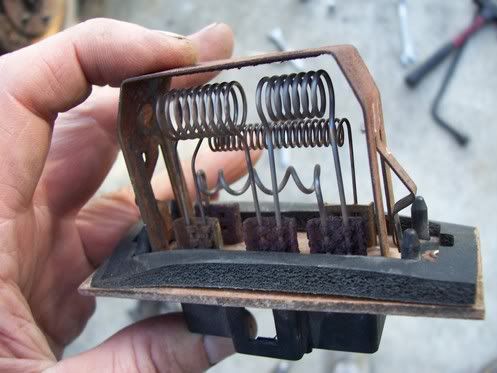 The resistor connector was badly corroded and burned and will have to be replaced in this picture. The resistor block blade connectors were rusted into the connector plug and literally had to be pulled apart with channel locks. 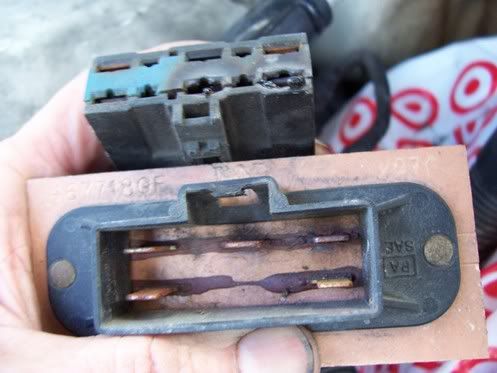 * * * End... by John Wood/Allpar.com: Jan 7 2006, 09:33 PM * * * If you need to repair Resistor Block Wiring, here are a few MORE great pictures and comments contributed by John Wood (Thank you, again John!)... * * * Start... by John Wood/Allpar.com: Jan 11 2006, 08:00 PM (this is an actual installation!) * * * I got my resistor and connector pigtail in today to repair my corroded resistor and burnt wiring connector. I took some pictures of the repair process. New parts: 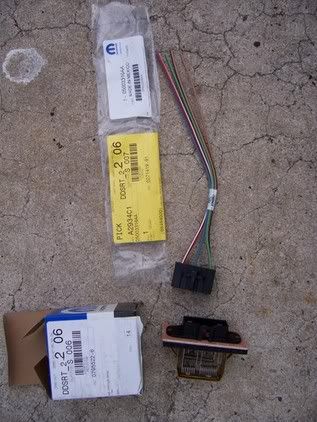 Soldering on new pigtail (they don't give you the heat shrink tubing but Home Depot has a nice supply of marine grade tubing). 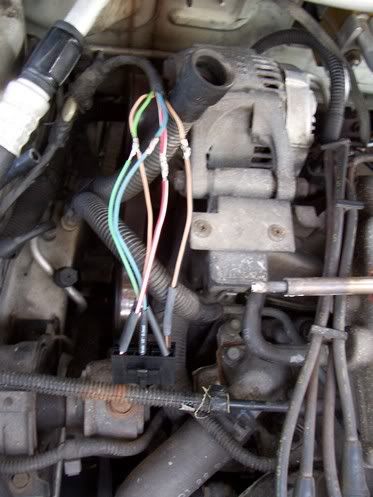 (Ed note... notice in this picture that the heat shrink tubing is now covering the soldered wires): 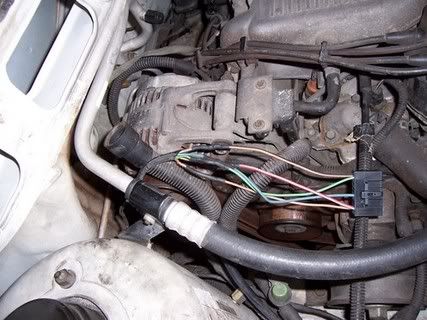 Here is where it goes (Ed. note... the Resistor Block goes INTO the rectangular hole where John's fingers are sticking out): 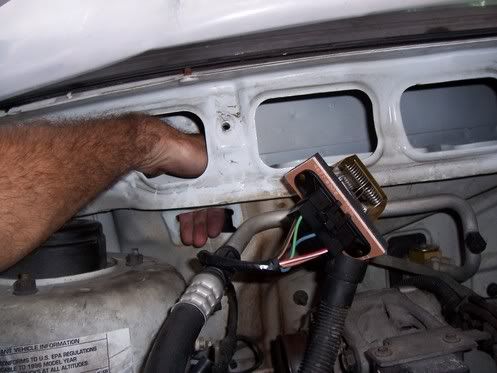 That was about $35 in parts but should finally resolve the missing blower speeds. * * * End... by John Wood/Allpar.com: Jan 11 2006, 08:00 PM * * * 3.) BLOWER MOTOR RELAY - I have considered strangling the Dodge engineer who "designed" this device to reside in its installed location for the '96 Minivan. If your Minivan is a '97 or '98, location may vary. This is by far THE most difficult component to replace in a 1996 model, but it is also among the least expensive ($8-$13)... and doing so can resolve one or more of a number of problems. Get your tools out and allow between 1-2 hours for disassembly, replacement and reassembly. No kidding. You'll need a Phillips screwdriver, a 10mm socket and ratchet with a 6-to-8-inch extension, a flashlight and some electrical tape. NOTE: In a 2005 Caravan, "The relay is in the main fuse/relay box under the hood between the battery & fender on driver's side. The box lid has the locations on the under side. - pwilliams517" NOTE: In a 1997 Grand Caravan, "Production date = 7/96 - title and owners manual (is a) 1997 (Grand Caravan). The PDC is under the hood with the relay at position 5, fuse at position 3... {this per the diagram in Chilton's}" - carolinaquestions/AutomotiveForums.Com a.) Remove the plastic facia below the steering column (4 or 5 Philips-head screws). b.) Disconnect the parking brake cable from the facia (make a note about how the cable is attached - you have to lift the cable up and slide it sideways/outward to remove it from the facia). c.) Remove the stamped-steel shroud beneath the steering column - it's (the one previously covered by the facia removed in Step b.) held on by about (12) 10mm hex-head screws - make a note of the screw types and their locations, there are 2 types of screws. d.) Disconnect the hood release latch. e.) Disconnect the computer diagnostics connector from the U-Channel crossmember. f.) Uninstall the U-Channel crossmember - removing several 10mm hex-head screws get this job done. Trust me, you WILL need the extra clearance to get at the Blower Motor Relay later. g.) Remove the Junction Box cover and unbolt the Junction Box (under the dash, driver's side, it contains relays and fuses, it also has the Body Control Module attached to its back) - there are three 10mm screws, each about 3 inches long that must be removed. h.) GENTLY pull the Junction Box as far forward as possible. Behind the Junction Box, up high and attached to a clip on the firewall, is the Blower Motor Relay. (Now you know why I have considered strangling the "engineer" for this flash of brilliance). You will recognize the Blower Motor Relay as a "black box" with four wires (blue, green, orange/black and black). It's size is about 1"x1"x2". i.) Carefully unclip/unfasten the Blower Motor Relay with wires attached from the firewall and GENTLY pull downward as far as possible. You will notice that a plastic depression clip holds the wired connector to the Blower Motor Relay... depress it and carefully pull the Blower Motor Relay out of its socket. IMPORTANT NOTE: On the firewall, make SURE you push and flatten the clip that formerly held the Blower Motor Relay against the firewall so it does not contact the BCM/Junction Block when you reassemble your Caravan. j.) You will notice that the OEM part has 4 prongs and your replacement part probably has 5; don't worry, the GP Sorensen, AC Delco and Hella parts work fine - I bought and tested ALL of them to make absolutely sure they would work. Plug your replacement part into the Blower Motor Relay socket with supreme confidence. k.) Wrap a piece of electrical tape completely around the relay and its socket - this prevents dirt, dust and moisture from getting into and around the contact points and also makes it much less likely that the relay will somehow work its way out of the socket. l.) Unless you are a certified masochist, do NOT attempt to reposition the Blower Motor Relay anywhere NEAR its original location. The special housing that came with the OEM relay is probably NOT part of the replacement part anyway (and do NOT attempt to reuse ANY piece of the old part). Keep the relay in view while you reassemble your Caravan and tuck/tape/bind it in any way you see fit after the reassembly is complete. That's what I did. Screw Dodge engineers. Anybody feel like storming Chrysler with torches and pitchforks by now? But hey, pat yourself on the back - you're halfway home on this one. Get a beer. Or a glass of wine. Or whatever. But only ONE. You still need to remain focused. m.) Starting with Step h., - reassembly is the reverse of disassembly. NOTE: After you have reassembled the dash, your new Blower Motor Relay should be visible underneath and behind the Junction Box/BCM... make sure it is out of the way of your feet when you drive. If necessary, tuck, tape or strap this in any way you see fit so it will not move around under the dashboard. At any rate, it will NOW be a whole lot easier to replace this relay again, should you ever need to do so. 4.) BLOWER MOTOR - located under/behind the glovebox/door. If the symptoms of your AC/heater blower problem indicates a motor replacement, take heart in knowing this is not THE most difficult task to finish. Still, I write about this because I continue to be horrified by the prices of so-called replacement motor parts - between $130-$175USD from dealers. Gadzooks. Fact is, the motor, only, cost me $45USD (about 1/3 the cost of the OEM unit which also includes the motor housing and fan/cage). To pull off this procedure, however, a certain amount of "handyman savvy" is required. a.) Remove the glovebox AND door... you may very well need the extra room. b.) Remove the Blower Motor cover (four screws). c.) Remove the Blower Motor ASSEMBLY (motor, fan/cage fan and fixture - three screws). You will probably need a flashlight to locate these screws. If you are NOT using the expensive OEM part and plan to reuse the motor housing and fan/cage, BE CAREFUL not to damage the fan/cage... it is "delicate." If you bought a complete and expensive OEM replacement motor/fan, STOP HERE. All you need to do is reinstall it. However, if you did what I did and bought ONLY the motor for about 1/3 the cost (and did NOT break the fan/cage when removing the old motor!), proceed to Step d. d.) FIRST, you must remove the old Blower Motor from its housing. There are 2 screws and 3 rubber bushings that center and hold the old motor in this housing. This is a little tricky, but it CAN be done. NOTE: According to Boother at Automotive Forums, "I simply took the clip off, sprayed some liquid wrench in the shaft and had a helper hold a screw driver on my bench and pushed the cage off. The screw driver was used to push in the shaft/motor while I applied force to the cage." If that doesn't work for you, proceed to Step e. e.) Remove the two screws from the bottom of the motor housing and, using a small flat-bladed screwdriver, carefully depress each of three rubber bushings to release the motor from its housing. NOTE: Be EXTREMELY careful NOT to damage the fan/cage in ANY way... if you do, it's GAME OVER and you MUST buy the expensive replacement unit from your dealer! f.) It IS possible to remove the fan/cage from the old motor for replacement on the new motor, but it requires VERY careful planning and execution. First, put the old Blower Motor tightly in a VISE, with the fan/cage upright (not tight enough to crush the housing, but tight enough to bang on it with a hammer [described below]). g.) Lay a hacksaw blade flat on the top of the fan/cage, with teeth facing the motor spindle. Carefully saw sideways through the top of the plastic shaft on one side. Place the hacksaw blade on the other side (180 degrees) of the plastic shaft and saw through the plastic shaft to the metal motor spindle again. You should now have 2 notches on either side of the spindle (opposite sides), through the plastic shaft. h.) Using a hammer and POINTED punch, score a dimple into the end of the metal motor spindle. i.) Using a hub puller, place the blades of the puller into the scores of the plastic shaft you created in Step g. Use a C-clamp to push the grips into these scores (a fair amount, but not too much pressure). j.) Rotate the hub puller clock-wise, centering the hub puller pin into the dimple you created in step h. Rotate the hub puller to gently lift the fan/cage about 1/2 inch UPWARD on the motor spindle. k.) Remove the C-Clamp and hub puller. You should now be able to carefully and EVENLY lift from the bottom the fan/cage up and off the motor spindle. BE CAREFUL! l.) The replacement motor I bought - I had to wrap this motor with a foam buffer strip (came with the motor) to properly fit in the stock OEM housing. You MAY have to modify the OEM motor housing in order to get the motor to seat FLUSH in housing - I had to carefully cut the center piece out of the end of the motor housing so I could get the motor to sit flush in the bottom of the housing. The two screws would NOT reach the new motor through the OEM motor housing otherwise. Make SURE the motor sits FLUSH in the bottom of the motor housing and the three rubber bushings are properly in place between the new motor and the OEM motor housing BEFORE attempting to screw in the two screws! m.) Once done, carefully press the fan/cage back onto the new motor spindle. I did notice that the new motor spindle length was about 1/8" longer than the old OEM motor, so the new motor spindle protruded by that same amount beyond the fan/cage shaft. As a precaution, I mixed up a little epoxy and dabbed the end of the spindle so the fan/cage DEFINITELY would not slide on the spindle. n.) Cut the wires (pigtail) off of the old motor as close to the old motor as possible (the black and blue wires with the grommet and plug... you will need to RE-USE this!) and strip the ends, leaving about 3/8 inch of exposed copper strands. o.) Cut/shorten the wires from the new motor, leaving about 4 inches... and strip the ends of these wires, leaving about 3/8 inch of exposed copper strands. p.) Using 10gauge/12gauge butts and proper crimping tool, attach the wires from the old pigtail to the wires on the new motor (black-to-black [ground-to-ground] FIRST, then the other wire, blue-to-whatever-the-other-color-is on the new motor). Make sure your crimps are TIGHT and wrap them well with electrical tape! q.) Reinstallation is the reverse of installation, beginning with Step e. It is easy to break the fan/cage while reassembling as well... so please BE CAREFUL. That's it... I invite, urge and encourage anyone and EVERYONE to jump on this thread to add, correct, clarify, whatever on this subject... I think WE can do a better job than Chilton, Haynes and Chrysler! Cheers! DOCUMENT REVISION HISTORY Updated 22-FEB-2006: Quick fix note for Blower Motor added. (Thank you Boother at AutomotiveForums.Com!) Updated 30-JAN-2006: Pic of 40amp fuse and source info added (Thank you Stevo2 at AutomotiveForums.Com!) Updated 18-JAN-2006: New NOTEs added regarding actual Fuse and Blower Motor RELAY locations in a 1997 Grand Caravan (production date 7/96) which differ in some respects from Haynes manual specifications (Thank you carolinaquestions at AutomotiveForums.Com!) Updated 12-JAN-2006: Truly EXCELLENT pictures and commentary regarding removal and installation of Blower Motor RELAY contributed by John Wood of Allpar.Com (Thank you John Wood at AllPar.Com!) Updated 06-JAN-2006: OEM Part Numbers and locations for 2005 Caravan Resistor Block, Blower Motor and Blower Motor Relay added... thanks pwilliams517 at DodgeTalk.Com! Updated 06-JAN-2006: OEM Part Number for 2001 Caravan Resistor Block added!... thanks Parky50 at AutomotiveForums.Com! Updated 04-JAN-2006: Good News for 1992-1995 and 1999-2005 Caravan, T&C and Voyager Owners added Updated 13-DEC-2005: 40AMP fuse replacement source Updated 12-DEC-2005: Resistor Block Replacement price and source (Rockauto.com)... thanks, clrbrown at AutomotiveForums.Com! Updated 15-FEB-2005: ADDED additional helpful detail to Resistor Block Replacement... thanks, ksflatfoot at AutomotiveForums.Com!) [Updated 15-FEB-2005: Define "PITA" - Pain in the As*... to replace a Resistor Block] [Updated 26-JAN-2005: Title change and description to reflect '96-'98 Chrysler Minivans] [Reworked 16-JAN-2005: Steps l.) and m.) of Blower Motor Installation Procedure] [Updated 16-JAN-2005: ADDED 40AMP PDC Fuse Locations for '97 & '98 Mini-Vans [Updated 16-JAN-2005: ADDED a few Helpful Notes about Blower Motor Relay Installation] [Updated 09-JAN-2005: A few, minor, corrections] [Updated 06-JAN-2005: Old Blower Motor Pigtail Installation] [Updated 06-JAN-2005: COST Comparison Data ] [Updated 05-JAN-2005: Misc. NEW information ] Last edited by HeadlessHorseman; 02-24-2006 at 08:07 AM. 
|
|
#3
02-06-2005, 11:04 AM
|
|||
|
|||
|
I would just like to say 'Shazam'...
That's some seriously wicked post you have there Headless...I have a 1992 Dodge Grand Caravan (base model), and although your instructions are not specific to my year and particular model, they were very helpful in sorting our the issues I 'was' having with my front heater blower that conked out yesterday...and just an add on for ya, my vent temperature isn't all that hot, I've been told that a Rad. flush will solve my problem (hopefully after removing all that corroded crap, I don't leak anywhere)...I'll let ya know with an update to this post...
|
|
#5
02-13-2005, 04:15 PM
|
|||
|
|||
|
heater resistor
Thank you for the detailed information regarding the resistor. It is most helpful. I have been trying to figure out where the resistor is in order to replace it. I just couldn't figure out where it is. I learned this is a dealer only item. A question for clarification though, do I remove screws from inside, and then pull it out and unplug the wires? I know it sounds easier than it is. I haven't been able to figure out what PITA is... I feel the same about Dodge engineers though. My Caravan has been a certified, class A money pit for the 3 years we have had it. Each time I spend a small fortune on it, I think surely this will be the end of major expenses and I can get my money's worth. A sorrier piece of waste I have never had the displeasure of driving. I want a vanity tag for the front "MONEYPIT"
ksflatfoot
|
|
#7
02-14-2005, 10:10 PM
|
||||
|
||||
|
What about this one:
The air flow changes when you step on the gas and directs it to vents that it is not set to come out of?
|
|
#8
02-15-2005, 08:18 AM
|
|||
|
|||
|
Re: 1996 Dodge Grand Caravan LE AC/Heater Blower, Relay and Resistor Block Problems 101
The door that directs the airflow in your vents is vacuum actuated, when you accelerate hard it will steal vacuum from that system and all the airflow will end up at the defrost vents.
|
|
#9
02-15-2005, 10:01 AM
|
||||
|
||||
|
Re: heater resistor
Quote:
I gather you own a Dodge Caravan... what year is it?... it might matter. However, it was NOT simple (for me at least) and I wound up cutting several fingers/knuckles, so please be careful... it may be tight and verrry difficult to get out. I found it impossible to disconnect the wire bundle from the Resistor Block prior to actually removing the Resistor Block from the firewall, so I carefully tugged/wiggled the connection until the Resistor Block came out of the firewall. I don't think it matters to disconnect the wires before or after you pull the Resistor Block out of the firewall. However, it *IS* important to disconnect the negative battery cable BEFORE you do ANYTHING... do NOT forget to do this !P.S. I love your MONEYPIT vanity plate idea. So true!
|
|
#11
04-09-2005, 03:24 PM
|
|||
|
|||
|
Re: 1996 Dodge Grand Caravan LE AC/Heater Blower, Relay and Resistor Block Problems 101
|
|
#12
05-21-2005, 11:45 PM
|
||||
|
||||
|
Old thread but, a big thanks to HH. Outstanding instructions on changing the blower relay. You saved me a lot of "Oh !@#$'s" and bandaids. Like you, I'm thinking the engineers sat around a table with a couple six packs and came up with a humdinger of a way to screw with the DIYers out there. They couldn't have put it in a worse spot. Cheers!
|
|
#13
05-22-2005, 03:28 PM
|
|||
|
|||
|
I was just curious if anyone had more info for a 97 caravan. My issue is that the blower will work fine when it is cooler weather, but after it sits in the sun for awhile the blower won't come on at all. The fuse is still good, I couldn't see anything wrong with the relay (located in the power distribution center under the hood) but how can you tell with a 1 x 1 black box, and I couldn't find anything wrong with wiring behind the glove box. I'm open to suggestions, just trying to avoid multiple trips to the parts store. The material in this post has been helpful.
|
|
#14
08-02-2005, 08:17 PM
|
|||
|
|||
|
Re: 1996 Dodge Grand Caravan LE AC/Heater Blower, Relay and Resistor Block Problems 101
I have a 1999 Caravan with symptom #1 (only runs the motor on high speed), does anyone know if this resistor block is in roughly the same location?
|
|
#15
08-02-2005, 11:01 PM
|
|||
|
|||
|
Re: Re: 1996 Dodge Grand Caravan LE AC/Heater Blower, Relay and Resistor Block Problems 101
Quote:
|
|
|
POST REPLY TO THIS THREAD |
 |
|
|







