

|
| Search | Car Forums | Gallery | Articles | Helper | Air Dried Fresh Beef Dog Food | IgorSushko.com | Corporate |
|
#16
 01-14-2011, 07:52 AM
|
|||
|
|||
|
Re: 85 Caprice Transmission oddities
[quote=silicon212;6859382]Dude WHERE DO YOU GET YOUR INFO FROM?
I'm sorry but I see so much damn misinformation in this thread it's pathetic! A half-mile of vacuum line? A half mile in HO scale perhaps? Not even that much! I'd be surprised if there are more than 30 feet of vacuum line on the entire car, air conditioning included, and that includes hard line and the steel purge line to the fuel tank! Dex III in a TH700R4/TH350C is just fine, no need to get him into synthetics for this transmission! So, it's no longer 'licensed'. That doesn't turn the chemistry into junk all of a sudden. Likewise, a dirty filter won't make the lockup screw up, but it could make the transmission slip. [quote] this poster did not state what engine troubleshooting was done. the vacuum lines are a big problem with this age of vehicle ..OK not a 1/2mile but when you start replacng it will surprise you how much is needed.. the use of dexron III now , which is no longer licensed by GM means this is now made by who ? and under what specifications ?..none are listed ... since GM no longer has a spec label on these so called dexron III containers made by who??????????? CHINA ! ONE MUST USE CAUTION.. gm states the approved fluid is now dexron VI. this is not my opinion ..I agree these transmissions can use dexron III , but with the GM spec on the container , this would now not be available.. these transmissions of this era from day one had the erratic 3/4 shift around 40 MPH.. this is why many had failed.. occationally this happens with my 84 ..so I drop it into 3rd .. you are correct this posting is lacking in any tests made /results etc.. just desription of his issues .. 
|
|
#17
01-14-2011, 10:21 AM
|
||||
|
||||
|
Re: 85 Caprice Transmission oddities
Dexron VI is synthetic oil. Dexron II/III is dino oil.
__________________
1988 9C1 - Modified LM1 @ 275HP/350TQ - TH700R4 - 3.08 8.5" Disc Rear - see it at http://www.silicon212.org/9c1! 2005 Crown Vic P71 - former AZ DPS - 4.6 liters of pure creamy slothness! 1967 El Camino L79/M20 old school asphalt raper Remember - a government that is strong enough to give you everything you need, is also strong enough to take everything you have.
|
|
#18
01-14-2011, 03:21 PM
|
||||
|
||||
|
Re: 85 Caprice Transmission oddities
Quote:
Since you said that the brake pedal disengages it, but it resumes when you stop braking, this would be where I would look (the switches, and/or the ECM). I'd put more weight on one or more of those switches being the issue. At this point, I'd probably discount the solenoid itself as the root of the problem.
__________________
1988 9C1 - Modified LM1 @ 275HP/350TQ - TH700R4 - 3.08 8.5" Disc Rear - see it at http://www.silicon212.org/9c1! 2005 Crown Vic P71 - former AZ DPS - 4.6 liters of pure creamy slothness! 1967 El Camino L79/M20 old school asphalt raper Remember - a government that is strong enough to give you everything you need, is also strong enough to take everything you have.
|
|
#19
01-14-2011, 03:32 PM
|
|||
|
|||
|
Re: 85 Caprice Transmission oddities
Quote:
dexron III made today is , who knows what it is made with , or how ! could be whale oil . so what if dexron VI is a synthetic oil..If GM says its the dexron III replacement why question this fluid useage..HERE .. if the solenoids are sticking it can be a fluid or contamination issue..
|
|
#20
01-14-2011, 05:41 PM
|
||||
|
||||
|
Re: 85 Caprice Transmission oddities
Quote:
As far as "why question this", why not? Do you always blindly use what you're told to use, or do you like to find the best solution for the application? I'm the second and I know that from a personality issue (MBTI) I don't have a lot of company in this, but keep in mind that there's always a better way. Just because GM says "do it", why leap before you look? Also regarding whale oil: Aside from the ethical and legal ramifications of the use of such, remember the original Dexron fluid was formulated as such, and when it was discontinued in 1973, damage occured to the cooling systems of vehicles as a result of its replacement and that's why Dexron II came out. Just saying. Also pertaining solenoids: Re-read what I wrote above. Solenoid has pretty much been ruled out; it seems to be operating correctly. I'm not going to explain my conclusion on that further than by asking you to revisit what's written above. I'm going to defer any further comment about the chemical makeup of the various fluids over to someone with more technical/engineering experience with oils such as Blue Bowtie. Who knows, I could be totally wrong and you could be correct, but I don't believe so. At any rate, I am not going to advocate total oil change on a transmission this old. You can Google the reasons.
__________________
1988 9C1 - Modified LM1 @ 275HP/350TQ - TH700R4 - 3.08 8.5" Disc Rear - see it at http://www.silicon212.org/9c1! 2005 Crown Vic P71 - former AZ DPS - 4.6 liters of pure creamy slothness! 1967 El Camino L79/M20 old school asphalt raper Remember - a government that is strong enough to give you everything you need, is also strong enough to take everything you have.
|
|
#21
01-14-2011, 06:20 PM
|
|||
|
|||
|
Re: 85 Caprice Transmission oddities
Quote:
gm in its droping this fluid as a transmission fluid , did so because the fluid became acidic after low amount of miles driven ..so it was revealed about 20,ooomiles that this fluid was breaking down.. thats why I say why question a company that admits its recommended fluid is not up to its expectations? hell I 'm no engineer . being in the repair of transportation equipment I have good experience with manufactures recommendations on what fluids to use ..use the wrong fluid you usually loose.. not to pick on a particular supplier , but you think Advance AUTO DEXRON III would take care of any damage ? I used that whale oil ! never had any problems..
|
|
#22
01-15-2011, 02:16 PM
|
||||
|
||||
|
Re: 85 Caprice Transmission oddities
Some of the earliest model ECM controlled TCC lockup parameters would engage at 31 MPH and release at 27 MPH. That's pretty low. My '86 was that way until I bumped up the settings in the program. Some cars kept the vacuum switch for TCC operation into the '80s. If this is an export model that might be the case. Canadian cars kept these very late in the series, but I believe they were all done before 1985. If the car has a vacuum switch for TCC control the problem could be in that switch or its adjustment. With ECM control, if the TCC releases below about 27 MPH it could be normal. If it remains locked below that speed but ALWAYS releases upon application of the brake, I would suspect a different problem in the wiring outside the trans, such as an ECM output issue. It may be important to find that out before tearing into the transmission again.
The TCC receives power from the GAGE fuse through the brake switch. The ECM only provides the ground to the TCC solenoid. If the wire harness is shorted/grounded somewhere upstream of the ECM the TCC can apply at any time regardless of the ECM control. In this case the brake switch would still interrupt the TCC circuit. If the wire harness or ECM output is grounded this will be revealed by monitoring the ALDL as described below. You can rig a test light into the ALDL socket inside the vehicle to monitor the TCC control system. Connect a 12V lamp to Pin F of the ALDL connector and provide a 12V source to the other lead of the lamp. The lamp should light any time the ECM tries to activate the TCC. If the light is always on, there is a problem in the wiring or ECM. 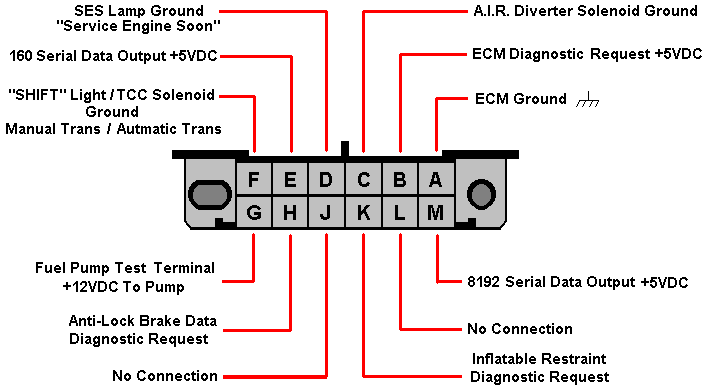 This may give you a much clearer idea of what is happening. If you determine the control system is functioning correctly, dropping the pan, oil, and filter and possibly removing and cleaning out the pressure switch ports in the valve body might be beneficial. It would be easy to remove and clean the TCC solenoid at the same time, but it would seem that the TCC solenoid is functioning electrically since it reportedly always drops on brake application. If you do remove the pan again, installing a drain plug is easy and almost always a good idea. I bet you wish you would have done that last summer.
__________________
Permanent seat assignment on the Group W bench... Automotive Forums Survival Guide
|
|
#23
01-15-2011, 04:01 PM
|
||||
|
||||
|
Re: 85 Caprice Transmission oddities
FWIW, early transmissions specified whale oil. I wonder if there is a lonely school of narwhals floating around the eastern Pacific with big blue GM logos on their sides with nothing to do any more, no purpose in life. Or, would that be porpoise?
The point is that dirty oil made 15 years ago by Kerr/McGee under license from GM is probably not as good as clean oil made by RD Shell in Brazil with no license. If switching to clean oil resolves the problem then it would have flushed out sludge and varnish, which means it should be changed once again. THAT would be a good time to go synthetic. Millions of vehicles ran billions of miles on this oil formulation for many years. Better products are always available, and once the problems are resolved switching to a synthetic is probably going to provide the longest life. Until the solution is reached, that may be a waste. I have rebuilt several transmissions and always run the first 1,000 or so miles on mineral oil. I do the same with engine break-in oil. I’m not saying it’s the only way to go, but it has worked for me. Pulling a drain plug and replacing the trans oil after break in is easy.
__________________
Permanent seat assignment on the Group W bench... Automotive Forums Survival Guide
|
| ||||||||||||||||||
 |
POST REPLY TO THIS THREAD |
 |
|
|






