

|
| Search | Car Forums | Gallery | Articles | Helper | Air Dried Fresh Beef Dog Food | IgorSushko.com | Corporate |
|
|||||||
| Car Comparisons Compare any cars and find out what every body else thinks. Just refrain from making stupid comparos like Viper vs. Geo Metro :) |
 |
 Show Printable Version | Show Printable Version |  Subscribe to this Thread
|
|
|
Thread Tools |
|
#16
 02-02-2005, 04:08 AM
|
||||
|
||||
|
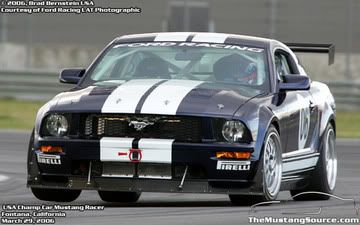
To anyone who has any doubts about how good a three-link solid axle rear suspension is on track, simply consider this: The bog standard rear suspension for SCCA GT5-1 IS a three-link solid rear.
Next time one of those tube chassis wunderkind 240SX's or Camaros is in the pits at a regional track-day, take a look at the rear suspension and you'll see it's the case. A solid axle suspension with good geometry will always outdo an independent suspension with mediocre geometry. And most folks forget the reason independent is used in road cars. It's not cheaper to manufacture or inherently more reliable, but it's easier to make a car that handles well enough and is comfortable. Most of the Camaro's complaints centered around a harsh ride that was caused by going too far to a rigid suspension for good handling. The new Mustang GT handles just fine for ANY car in its price range and isn't handicapped with its live rear axle. There's a shade of understeer at the corner entrance (that could be cured by some non-all season tires) and a little bit of oversteer at corner exit that's easy to catch. No histronics. No axle tramp. No snap oversteer, just an easy to gather up coupe that'll run with the rest of 'em.
__________________
Proud Owner/Operator of Haven Raceway and Hobby! 
|
|
#17
02-04-2005, 01:09 AM
|
|||
|
|||
|
Re: How's the new Stang's Handling compared to
Quote:
|
|
#18
02-04-2005, 01:32 AM
|
||||
|
||||
|
Eheh, nice try junior. Live axle suspension setups are actually LIGHTER than independent. Fewer components, remember?
Your statements on damping are theoretically correct but hinge entirely on the geometry of the control arms. Take into account a leaf-sprung live axle rear suspension. The travel is determined by the length of the primary leaf measured against the height of the primary mounts. (mount height = bound length, primary leaf length = rebound length). The roll of the suspension is determined by how far apart the leaves are mounted. In a car such as my MGB, which has short primary leaves and wide leaf spacing, there is very little roll or rebound, which allows for softer springs which then allow for better handling over a rougher surface. In control arm/coil spring setups determining the geometry is much more complex, but equally determines the basic handling characteristics. You go over damping and unsprung weight like they're the most critical things. I've designed ground up suspensions, and I'll tell you this, it's all about the geometry. EVERYTHING else is totally unimportant.
__________________
Proud Owner/Operator of Haven Raceway and Hobby!
|
|
#19
02-04-2005, 02:03 AM
|
|||
|
|||
|
Re: How's the new Stang's Handling compared to
Quote:
Last edited by CrzyMR2T; 02-04-2005 at 03:09 AM.
|
|
#20
02-04-2005, 05:22 AM
|
||||
|
||||
|
You assume far FAR too much.
A suspension's concept - be it live axle or independent - is purely PURELY theory. The design lies in the application of that theory to geometry, and then the components determine the soundness of the application. One concept does not work better than another concept. A design can be better than another design regardless of concept. You bring up a classic example of the live axle concept's inherent weaknesses. When the chassis of a live axle car does not move parallel to the axle, the contact patch of both tires is lessened. As such, the most common way to compromise on this is to absolutely minimize the amount of travel allowed by the suspension geometry - thus ensuring that at least one tire always maximizes its contact patch. The team I was on when we designed the 1996 Bodnar supermodified chassis used this to our best advantage, creating a lightweight solid-axle front suspension that offered up uncanny grip and gave us the most nimble supermodified chassis on the ISMA (and later MSA) circuit.   You talk about "leaf springs" being inherently heavy compared to modern suspension. Most "modern" leaf springs are still spring steel because they're used in truck applications. A performance leaf spring (although used in a transverse independent suspension) can be found in the C5 and C6 Corvettes. Their leaves are composite fiberglass resin which makes them incredibly light. Again, components determine the soundness of the application. For that matter, the weight of a rear axle. Yes, hoisting around a Ford 9in rearend is a two man job. However, (while unwieldy) I can very easily lift and move the rearend of my MGB. The larger components can be more robustly built for less money. To make smaller components more durable, you must build them with more precision and with higher grade materials, thus costing more money. A trade-off made when constructing an independent suspension. If you were to construct an independent suspension for the cost of a live axle with the same quality materials as a live axle, it's damn certain that the independent suspension will fail. I've seen too many supermods experiment with independent suspensions and fail because of poor durability for that exact reason. There is always a compromise in suspension design, and it is made because every concept is flawed. Independent suspension is often the concept that offers the best compromise for some designs. In other designs, it does not. I did not set out to argue that live axle is better than independent, but to prove that neither is an unsound concept. My experience has proved otherwise. When you take a suspension concept, give it a good design with carefully chosen geometry, and then apply it with good quality components, you will have a good handling (or whatever other goal you're looking for) suspension. So long as one is mindful of this, ANY suspension can offer up truly good handling. This is why Corvette has used transverse leaf springs since 1963, why Lotus stuck with the backbone frame, and why the new Ford Mustang can be a barnstormer on a road course.
__________________
Proud Owner/Operator of Haven Raceway and Hobby!
|
|
#21
02-04-2005, 07:26 AM
|
||||
|
||||
|
Re: How's the new Stang's Handling compared to
Quote:
__________________

|
|
#22
02-05-2005, 02:22 AM
|
|||
|
|||
|
Re: How's the new Stang's Handling compared to
Quote:
|
|
#23
02-05-2005, 02:57 AM
|
||||
|
||||
|
Every word out of your mouth is just further proof you know nothing about suspension theory, design, or application.
I like how you're trying to leap on the supermodified as completely irrelevant because it's a circle track car. Nice touch, and predictable for someone who's clearly licking Japanese boots. What you argue is component. I bring up that most production leaf springs are heavy as they are spring steel but that Chevrolet has proven that leaf springs can be manufactured to be lightweight. That these leaf springs haven't been used in anything except the Corvette/XLR independent suspension is ENTIRELY irrelevant when discussing suspension design. What is relevant is that the technology to make a lightweight solid axle/elliptical leaf spring suspension is readily available and not prohibitively expensive. You always bring up "all things being equal", unfortunately, this is never the case in design. As I've said all along, different concepts require different compromises in design. Say you have a specific set of travel parameters to design into a suspension. You need x amount of bound, y amount of droop, n amount of camber gain through the arc of bound travel. In order to meet your x, y, and n requirements with different suspension concepts, you'll need entirely different suspension designs. For instance, strut suspension tends to have very little camber gain through the bound travel unless the control arm is very long relative to the height of the strut. However a short strut results in very little natural bound unless the strut connects to the spindle/control arm closer to the chassis pick-up point of the control arm and not the spindle pick-up point. Unfortunately, mounting close to the chassis pick-up point makes droop hard to come by unless you mount the strut low, which compromises the camber gain. So you continue moving around the components until you determine what geometry meets your parameters. Then the guy upstairs hands you the dimensions the chassis is going to be and how much of those dimensions is allocated for suspension mounting, and you have to scrap your whole suspension design because the geometry to make the concept work simply won't fit in the dimensions. This is the key point, and I'm going to put it all in bold so that it'll make it through your thick skull: IT IS NOT THE SUSPENSION CONCEPT THAT DETERMINES THE SUSPENSION'S QUALITY. IT IS THE DESIGN AND THE APPLICATION. You cannot compare suspension concepts because that is all that they are. You insist on bringing up application examples to prove the inferiority of the concept, yet have yet to establish one thing inherently wrong with the concept. If you want to argue suspension concept with me, start coming up with something a lot better than "Well, if it was better than F1 would use it." Guess what, the concept doesn't fit F1's application, ergo it's not as good for F1 as an unequal length A-arm suspension. In order to set up each corner of the car independent of each other for maximum potential on a specific road course, F1 needs independently adjustable suspension. If you take a good look at different teams' suspension's, you'll see many different applications of the unequal length a-arm concept, and some work much better than others. But they all use the same basic concept not because it's the best concept, but because it's the concept that fits their compromise. And, if you really want to get technical, we should mention that F1 "suspensions" no longer include pivot points and instead the damping is done by tuning the rigidity of the carbon fiber of the control arms so that they flex at specific rates. This flex is damped with pushrod enacted torsion bars mounted in the monocoque. F1 suspensions haven't had a droop or bound of more than a few token centimeters since they banned active suspension in the early 90's.
__________________
Proud Owner/Operator of Haven Raceway and Hobby!
|
|
#24
02-05-2005, 05:29 AM
|
|||
|
|||
|
Re: How's the new Stang's Handling compared to
Quote:
Last edited by CrzyMR2T; 02-05-2005 at 06:00 AM.
|
|
#25
02-05-2005, 11:18 AM
|
||||
|
||||
|
Re: How's the new Stang's Handling compared to
Sorry if I'm butting in, but maybe a 3rd person perspective will clear this up.
CrzyMR2T, Layla's Keeper is not arguing that a solid axle design is better than an IRS. He's arguing that it is better -in application-. You keep using terms like "most likely", "could be", and "should be". Start putting up some solid proof that IRS is inherently superior to solid axle...but you can't do that, because some of the fastest and cheapest cars you'll find at race day use advanced solid rear axle systems.
|
|
#26
02-05-2005, 01:30 PM
|
||||
|
||||
|
Yes kman, finally someone with the mental capacity to understand what I've been saying. What I've been saying is that you cannot discount a solid axle suspension as inherently inferior simply because it is a solid axle suspension.
You can only compare the geometry of the design and the application of the components. Concept = theory, and a theory remains a theory until it's in practice. And there are too many examples in practice of poor/excellent handling independent suspensions and poor/excellent solid axle suspensions in all forms of motorsport to have a definitive answer. Should I point out that the GTS class qualifying record at Daytona was broken by Rocketsports Racing's converted Trans Am Jaguar XKR's? A solid axle, four link, carbureted OHV 310ci V8 beast that slaughtered the old 300ZX record.
__________________
Proud Owner/Operator of Haven Raceway and Hobby!
|
|
#27
02-05-2005, 04:03 PM
|
|||
|
|||
|
Re: How's the new Stang's Handling compared to
Quote:
|
|
#28
02-05-2005, 04:13 PM
|
||||
|
||||
|
Re: How's the new Stang's Handling compared to
Quote:

__________________
 SoStAsSaId: and the flight attendant is cute... if i was a lesbian, i'd join the mile high club  <---call this number <---call this number
|
|
#29
02-05-2005, 04:48 PM
|
|||
|
|||
|
Re: Re: How's the new Stang's Handling compared to
Quote:
|
|
#30
02-06-2005, 02:13 AM
|
||||
|
||||
|
It makes sense to me that handling setups depend on the application. I will agree with that. So for the SHELBY MUSTANG COBRA, I am eager to see what the beefed up live rear axle can do. I am very excited about this new cobra. The article I read stated that alot of research went into choosing a suspension setup and the best OVERALL (price and handling ability) choice was the live rear axle they engineered. We'll see how it does... anybody else got news or inputs?
__________________
|
|
|
POST REPLY TO THIS THREAD |
 |
|
|






