

|
| Search | Car Forums | Gallery | Articles | Helper | Air Dried Beef Dog Food | IgorSushko.com | Corporate |
|
|||||||
| Forced Induction Discuss topics relating to turbochargers, superchargers, and nitrous oxide systems. |
 |
 Show Printable Version | Show Printable Version |  Subscribe to this Thread
|
|
|
Thread Tools |
|
#47
 09-21-2004, 10:16 PM
|
||||
|
||||
|
Re: Turbo delay.
hhhmmm, heres an idea. mate the compressor u got now to a smaller turbine, should reduce some lag. don't know why people haven't thought of that yet??? and/or spend some more money for some ball bearings.
__________________


|
|
#48
09-21-2004, 10:24 PM
|
|||
|
|||
|
cbrfryman: I assume you were referign to a t3/t4 since T3's aren't all that big. However that was my point its hard to boost 30 lbs on a regular size turbo, I thought you were claiming that you could always increase the boost by increasing the turbine speed, and obviously you can't do that indifnately since it would destroy the turbo. saabjohan was refering to turbo compounding for disel trucks which alows massive amounts of boost.
Tran_nsx: It sounds like your talking about a T3/ T4 setup to me. The turbine is from a T3 turbo ( used in passenger cars) and the T4 part is a large compressor.
|
|
#49
09-22-2004, 12:24 AM
|
||||
|
||||
|
Re: Turbo delay.
Quote:
__________________
|
|
#51
09-23-2004, 01:47 PM
|
|||
|
|||
|
All diesel engines are not state of the art with electronic control variable geometry turbines. Also, if you're building a high performance diesel there is usually no need for variable geometry, and in racing it's sometimes forbidden. Take a look at the Ricardo-Judd V10 turbodiesel for example, 600 hp at 6000 rpm, two fixed geometry turbochargers feed the engine with pressurized air, the turbochargers are equipped with inlet restrictors according to regulations and they doesn't use wastegates.
Variable geometry turbochargers are usually also sensitive to high exhaust temperatures. Garrett Variable Nozzle Turbine 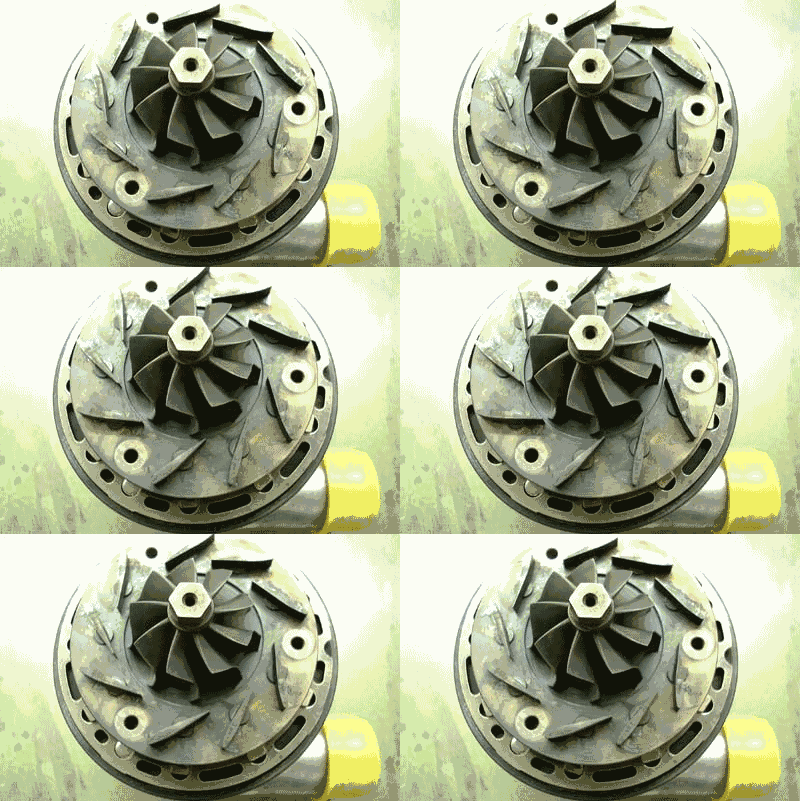 The reason that you don't mix a large compressor with a small turbine is that they simply don't match. The small turbine use high speeds, work with low massflow rates and makes a low power. The large compressor work at lower speeds, work with high massflow rates and consumes more power. Garrett T3 and T04 are really old stuff, altough they have been further developed they are originally back from the 60-70:ties. There are much better turbochargers availible today. Using high boost pressures isn't that strange, it's just a different compressor design that must be used, one that work only under more narrower conditions. The turbine output must also be optimized. This is usually done by using a larger turbine, often matched with a smaller turbine housing. Most smaller turbochargers are matched for small gasoline engines and aren't built fo higher boost pressures, that isn't the case with for example the larger of the GT turbochargers from Garrett or the HX series from Holset. Typically special "high pressure ratio" compressors are also availible, for example Holset offer HPRC in cast titanium. Many small turbochargers also doesn't have bearings with are designed for higher loads caused by high pressure ratios, many small Garrett turbochargers do for for example use 270 degree thrust bearings while other turbochargers are equipped with 360 degree thrust bearings or even ceramic ball bearings.  A compressor map showing the principle, it's on german since I took it from BorgWarner Turbosystems homepage (the brands KKK and Schwitzer). X-axle - volume, or massflow Y-axle - pressure ratio Pumpgrenze - usually refered as surge-limit limit in english. This line cannot be crossed as it leads compressor surge, that it the air stalls in the compressor and the compressor can no longer pump air. Stopfgrenze - usually called choke. Passing this line will not increase the flow from the compressor due to that sonic speeds have been reached in the compressor. From this point on all extra volume flow measured after the compressor, or boost comes from that the air is heated, mass flow or volume flow before the compressor will not increase. Power output from the engine will also not increase. blue-green-lines - this is the adiabatic efficiency of the compressor. This relates to how much the air will be heated and the specific work required by the compressor. red-lines - this is turbocharger speed, the highest of the lines is the maximum speed. Note that the highest speed isn't equal to the highest pressure ratio (boost). Maximum flow is reached at 200k rpm and a pressure ratio of about 2.1 while 180k rpm is enough for the same pressure ratio with 80% of maximum flow. The problem with using nitrous with turbocharging is usually because the turbine won't handle the higher flow. Running with the wastegate open is not only inefficient, many original wastegates can't handle much more than the original flow. I know other people which also knows quite a lot about turbocharging and they have had similar concerns. In some cases even what the "tuning companies" use can be enough to cause concern, and in some cases the airflow isn't enough to match their power claims. When the car manufacturers do their development they usually fit them with sensors for exhaust temperature as well as turbocharger speed.
|
|
#52
09-23-2004, 05:04 PM
|
||||
|
||||
|
Re: Turbo delay.
Quote:
__________________
|
|
#53
09-23-2004, 05:57 PM
|
||||
|
||||
|
Re: Re: Turbo delay.
Quote:
wut do u think a t3/t4 turbo is??? its a t3 flange and turbine side with a t4 compressor side.
|
|
#54
09-23-2004, 06:02 PM
|
||||
|
||||
|
Re: Re: Re: Turbo delay.
Quote:
 . read the guys quote and my reply again. . read the guys quote and my reply again.oh and here is the proof for saabjohan : http://www.turboneticsinc.com/t3-4.html
__________________
|
|
#55
09-26-2004, 05:29 PM
|
|||
|
|||
|
Re: Turbo delay.
WOW WOW people back to the topic, nvm do whatever. i got it figured out, 3 inch muffler system (entire system manafold and all) td04 turbo (spools at 1500 prm i belive) wider intake, blow off vlave canvert to manual trans. well thats it thanks all.
|
|
#56
09-30-2004, 02:28 PM
|
|||
|
|||
|
Re: Turbo delay.
The T04B and E compressors used are only slightly larger than the original compressor. Also, these turbos usually don't work so well in high boost applications when powerconsumption from the compressor increase. Take a look on the turbochargers used in F1 during the eighties, large turbines fitted in small turbinehouses to improve turbine efficiency and then a quite large compressor to that. Or why don't look on how a turbocharger looks on a diesel for a truck, large turbines which can power the compressor efficiently.
The basics behind matching is the same as for jet engines. http://www.grc.nasa.gov/WWW/K-12/airplane/ctmatch.html
|
|
#57
10-11-2004, 04:28 PM
|
|||
|
|||
|
Re: Re: Re: Turbo delay.
Quote:
Second - turbochargers do not compress the intake air for free. True, they ARE powered by the exhaust flow, but some power (efficiency?) is lost since the exhaust doesn't flow as well. Not many crank-driven superchargers take 600HP to run - the exception being the Roots blowers on Top Fuel dragsters. They can eat up to 800HP. I'm not sure about the exhaust advice - I'll read up a bit on backpressure and such and I'll try to edit my post if necessary.
__________________
Some things are impossible, people say. Yet after these things happen, the very same people say that it was inevitable.
|
|
#58
10-11-2004, 05:07 PM
|
||||
|
||||
|
Re: Re: Turbo delay.
Quote:
__________________
|
|
#59
10-15-2004, 11:56 AM
|
|||
|
|||
|
Re: Re: Re: Turbo delay.
Quote:
|
|
|
POST REPLY TO THIS THREAD |
 |
|
|








