

|
| Search | Car Forums | Gallery | Articles | Helper | Air Dried Beef Dog Food | IgorSushko.com | Corporate |
|
|||||||
| Engineering/ Technical Ask technical questions about cars. Do you know how a car engine works? |
 |
 Show Printable Version | Show Printable Version |  Subscribe to this Thread
|
|
|
Thread Tools |
|
#31
 09-19-2006, 10:42 AM
|
|||
|
|||
|
Re: high reving in large displacement engines
That is indeed reducing the bearing surface speed and is one reason why the 283 and 302 can rev higher. Your redline of 6500 is pretty acurate for a "stock" bottom end 350. I think of stock as iron rods, crank and block with stock bobwieght. I always considered about 6200 as a max rpm as most "stock" springs will allow bounce or float above 6500 anyways.
Another thing you reminded me of when talking about reducing main bearing size is the overlap between the two crank journals, the larger the shaft size the stronger it is. I think the short stroke chevy also had small rod pins. 
|
|
#32
09-19-2006, 10:44 AM
|
|||
|
|||
|
Re: high reving in large displacement engines
How about a formula for bearing surface speed? It must be circumfurance times rpm or something like that? lol. I've always wondered about ball bearings in a car engine? probably won't hold up?
|
|
#33
09-20-2006, 04:09 PM
|
||||
|
||||
|
Re: high reving in large displacement engines
Quote:
the old Auto Union V16 engines used roller/ball bearings. but they were very complicated engines, the cranks alone had over 1,100 individually machined pieces.
__________________
Seatbelts Saved My Life 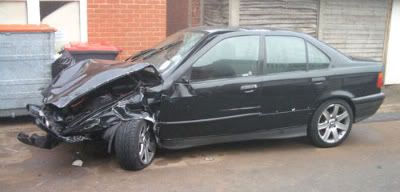
|
|
#34
09-20-2006, 05:39 PM
|
||||
|
||||
|
Re: high reving in large displacement engines
ill put my 2c in even though its all been probably covered just in different words.
bore is where power is, stroke is where potential is. very basically. it was mention how you need some of one to make best use of the other, which is true. stroke actually doesnt really matter as far as engine durability goes, as long as you can increase the size of the rod along with the stroke. also high revving engines need to have efficient rotating assemblies in the block in order to make high end torque, and need high flowing heads in order to make high end hp. but one thing about hp/tq is that, say if you make 200ftlb at 4000 rpm with your car, and do some mods, dyno it, and now you make 200ftlb at 5000 rpm, you will see a big increase in hp. the lower the torque peak is in the rev range, the lower the overall hp will be. some forced induction engines get partially around this fact with things like twin turbocharging, but for the most part it holds true. also, im not sure why diesel engines were included in this, they have low rev limits and huge torque figures for different reasons than gas engines.
__________________
|
|
#35
09-21-2006, 01:59 AM
|
|||
|
|||
|
Re: high reving in large displacement engines
Quote:
I heard once (and I have no reference to this) that stock 350's were TESTED to 7200 RPM's. IE, chevy feels thats a safe RPM for them. I feel confident saying that they could live at that RPM, but for how long, I wouldn't take a guess at. I would assume anyone that is really interested in making a 350 spin to 8K RPM's, and taking advantage of those RPM's, would be willing to spend a little money on the bottom end. Because they'll surely be spending money on heads and valve train!
__________________
life begins at 10psi of boost Three turbo'd motorcycles and counting. 
|
|
|
POST REPLY TO THIS THREAD |
 |
|
|









