

|
| Search | Car Forums | Gallery | Articles | Helper | Air Dried Fresh Beef Dog Food | IgorSushko.com | Corporate |
|
#16
 01-19-2002, 01:28 PM
|
|||
|
|||
|
hmm, so the intercooler adds power but gives more problems?
How does it give problems? anyone?
__________________
1998 Honda Prelude Full OEM kit AEM CAI PIAA Super Plasma's Clear Sidemarkers and Turn Signals Beltronics Radar Red Calipers 

|
|
#17
01-20-2002, 05:31 PM
|
|||
|
|||
|
not problems, but when you add a cooler, it ups the power, and the compression,b/c cool air is more compressed... boosted compressed cold air has a high comp ratio in a cyl... so you need a lower rate piston... drift'll explain it better...
|
|
#18
01-21-2002, 08:14 AM
|
||||
|
||||
|
Adding an intercooler will only help, it won't hurt. It makes the air going in denser by cooling the air. Hot air is less dense than cool air. Having cooler air is good because it increases the turbo's efficiency and makes more power. You won't run into any problems because installing an intercooler does not increase the compression of air, that's what turning up the boost does. Thus the term PSI, pounds per square inch.

__________________

|
|
#20
01-21-2002, 10:27 AM
|
|||
|
|||
|
basically... that is why you want cold air. more dense. cai's are so popular b/c you make more power that way... why? b/c the air is more dense... this is the poor man's compression ratio increase... that is why you make more power on a cool day than a 100 degree one...
so... if you have cold/ambient air coming in... as opposed to the non intercooled hot air, the compression is up... so you dont need to run as high of a boost setting... or if you do, you need to do the math and make sure your compression ratio won't blow your rings off your motor... and an intercooler, either a bigger more efficient one, or having one vs not having one, does increase boost, b/c the cool air is better/ more power production... and boost is not measured at the turbo, it is a manifold pressure reading... so if you run a turbo w/no cooler, than w/ one... difference there... sooooo.... a cooler will not hurt, unless you design a system that needs internal mods and you don't do em... that is what i am saying...
|
|
#21
01-21-2002, 02:00 PM
|
||||
|
||||
|
Just want to try to clear something up:
If you place an intercooler into an established turbo system, the dynamic compression (i.e. psi in the cylinder) will actually go DOWN. The amount of pressure in the turbo system is regulated entirely by the wastegate, long before the air ever hits the intercooler. When you put an intercooler into a system, the wastgate doesn't notice - it's still on the 'hot' side of the cooler, and it keeps the pressure right there where it used to be. But, as the air goes through the intercooler, it gets cooled. As the mass of air gets cooled, it increases in density and decreases in pressure. Thus, on the 'cold' side of the cooler you actually get LESS PRESSURE - but you still have the SAME MASS of air. Since you have the same mass of air in the cylinder, you'll get the same amount of fuel and the same amount of power. But now, since you're running cooler with less pressure, you don't have to worry about detonation. And now that you're not close to detonation, you can do other things to increase your power like upping static compression, increasing boost levels, advancing the spark, shortening the intake cam, etc. Upshot -> In a well-set up turbo system (no detonation) an intercooler alone produces no power increase, it just cools everything down. But that effect allows you to make other modifications (like more boost) that will net you more power (and heat things back up again  ). ).
|
|
#22
01-21-2002, 04:34 PM
|
||||
|
||||
|
Fritz, this has to be the first time I disagree with you! Clearly it's time for a lesson in how wastegates operate, let's start with some pics...
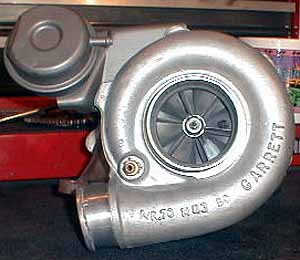 here's a wastegate selenoid from a Greddy turbo 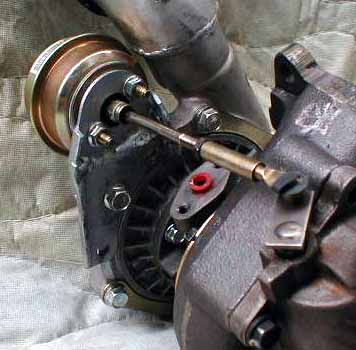 here's how the selenoid actuates the internal wastegate on the Greddy turbo 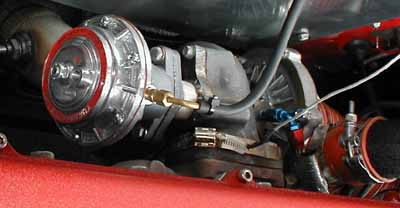 here's a shot of a Turbonetics Delagate external wastegate as installed on a turbo system Now, what do these pics have in common (ok smartass, other than the turbo)? Oh yeah, there's a little vacuum line nipple on both systems; for the internal wastegate it's on the selenoid, and for the external it's on the wastegate itself. But why, you ask, are there provisions for an air line to the wastegates? It's so the wastegate can do it's job of regulating manifold pressure to a preset level (set mechanically by a spring), and is the root as to why intercoolers can produce so much extra power AND dynamic cylinder compression on a turbo system. What the wastegate sees with this line is the manifold absolute pressure (unless there's a manual or electronic boost control valve mounted inline), and when you add an intercooler this pressure would normally go down. However, since the wastegate is looking to maintain a certain boost pressure relative to absolute, let's say 8psi for this example, what it really regulates to is 14.7 + 8psi = 22.7psi absolute. Adding an intercooler will naturally lower the current boost level at a given static turbo airflow level, since as everyone has clearly pointed out cooler air is denser and therefore has less internal pressure than the same volume of hot air. There's also some flow restriction imposed by the intercooler, but none of this matters, because what actually happens is that the turbo increases it's airflow level to make up for all this pressure loss. The wastegate is the only thing keeping the turbo from spinning up to much higher airflow levels, and since it's looking for 22.7psi of manifold pressure, it won't stop the turbo from increasing airflow until it sees that pressure. Since the intercooler is mounted before the intake manifold, the drop in pressure is negated by the fact the turbo increases airflow levels, so in the end you end up with greater air density AND greater overall volume. I do agree that intercoolers are pretty much a universal good thing, since dynamic compression is something you have much more leeway with than static compression and incoming air charge heat. Notice that you can run 8psi of intercooled boost on a 10:1 static compression Honda 4 cylinder, which should boost dynamic compression to around 15:1 and still work fine on pump gas. Yet you certainly can't run a 15:1 static compression ratio on even an NA version of that motor with pump gas, as you'll get immediate and catastrophic detonation. So remember that you can bump dynamic compression relatively easy on a turbo motor (such as with adding an intercooler) and still be safe in regards to engine function, but you can't add much heat to the overall mixture and come away clean. Static compression is basically a measure of how much heat is imparted to the compressed mixture, whereas dynamic compression is how much total air volume is being compressed. And although it might not seem there would be this big difference in terms of what an engine will handle before blowing up, there is. Ps- That first part of the post is also why a turbo setup is largely imprevious to altitude changes, in that a wastegate looking at manifold absolute pressure doesn't care what the ambient pressure currently is. It'll just have the turbo working harder to maintain the same level of overall boost, which may actually be closer to 12 psi above ambient at 5000 ft elevation than the 8 psi above ambient at sea level.
__________________
'03 Corvette Z06 '99 Prelude SH
|
|
#23
01-21-2002, 07:49 PM
|
||||
|
||||
|
Texan - you're absolutely right - if you take a pressure signal hose all the way from the intake manifold plenum, the air pressure in the cylinder will remain the same, but the density and mass will increase, resulting in more power.
But - I've never actually seen that done (although I haven't seen that many custom turbos...) There are a couple of problems with it. If you place the signal hose in the intake plenum, after the throttle body, the wastegate will shut tight whenever you're at low throttle (since it'll be seeing the plenum vacuum), resulting in a huge boost spike leading to a blown TB, overheated blow-off valve, or shattered compressor wheel. And even if you pull the signal hose from right before the TB, you may have problems with surging. Because there is a brief time delay between the wastegate shutting off and the positive pressure step getting through the intercooler and back through the signal hose to the wastegate - which then opens and makes a negative pressure step and the cycle repeats. At just the right RPM and load, it can self oscillate and the pressure will go nuts as the wastegate opens and shuts as fast as it can - possibly leading to surging and turbine failure.  This problem can be overcome, but it takes some very careful thinking... This problem can be overcome, but it takes some very careful thinking...This is how I've usually seen turbo set ups - with the pressure sender hose placed just a tiny bit after the compressor. I honestly think that is the typical way to do it. 
|
|
#24
01-21-2002, 08:15 PM
|
||||
|
||||
|
Well isn't that nice, and it makes complete sense. That's what I get for making an asumption, I've looked around online and can't find vacuum line placement anywhere other than the setup you pointed out... damn I hate assuming things! Still though, I'll take mine with an intercooler. Anyways, thanks for the correction fritz, I'm going to email my friend Jeff up north with the FMAX kit on his 5g to see just where FMAX places theirs.
__________________
'03 Corvette Z06 '99 Prelude SH
|
|
#25
01-21-2002, 09:51 PM
|
||||
|
||||
|
Just poking around the web bit shows that most production cars are set up as in the above picture (including DSM & Nissan engines). But I found an interesting thing about the Saab 9000 - it actually has a hose from both the end of the compressor and from the intake plenum. They go into a computer controlled solenoid, which gets to choose how much of each signal the wastegate actually sees. The add-on HKS electronic boost controller does exactly the same thing. Tricky!
So, if you have a fancy turbo computer and some solenoids on the vacuum line, adding a new or larger intercooler may actually give you an immediate boost in power, since the computer may automatically compensate for the loss in pressure due to the cooler. But I think most stock & even most aftermarket turbos will be set up as in the pic above, in which case, the intercooler alone will actually reduce your cylinder pressure (but not your power!) I'm curious to know about the Fmax kit. But I'll bet you a beer that it's just like the pic above. 
|
|
#27
01-22-2002, 08:10 AM
|
||||
|
||||
|
Buh Buh I'm scared too! I'm not going to try to answer anymore turbo questions! :hehehe:
__________________
|
| ||||||||||||||||||
 |
POST REPLY TO THIS THREAD |
 |
|
|





