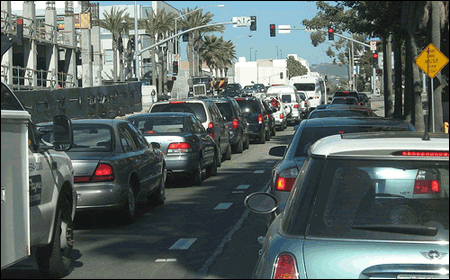
 Moving Violations:
Controlling Your Traffic Situation
When it comes to the constant battle of dealing with traffic,
Moving Violations:
Controlling Your Traffic Situation
When it comes to the constant battle of dealing with traffic,
the best offensive is to drive defensively
Jonathan Swigart - AutomotiveForums.com
Oct. 7, 2011
For the longest time, I was always led to believe that defensive driving is the same thing as aggressive driving. I was led to believe that it was the same as driving angry or recklessly and was not the most desirable way to negotiate traffic situations and that such driving was, in fact, dangerous for you and those around you.
Then I started driving and realized all of those things are absolutely false.
I was reminded why this morning as I made my way from dropping my son off to my office. During the 20 minutes of my commute, I had the (mis)fortune to get behind some of the most unaware, uninterested and unresponsive drivers of the day.
Whether it was taking their time to go through a light, driving slow in the passing lane, braking unexpectedly for no apparent reason or cutting me off because of the sudden need to turn right, I seemed to have a knack this morning for attracting inattentive drivers.
Were it not for the fact that I myself am a bit of a defensive driver, I probably would have been late for work. Fortunately for me, I don't make driving with tunnel vision a habit.
That said, I would like to extend an invitation to those of you out there who might be somewhat timid behind the wheel to join the ranks of a defensive driver. Not just for your own sake, but for the sake of the other drivers on the road who value their the ability to get from point A to point B in a timely fashion without incident.
According to American National Standard Safe Practices for Motor Vehicle Operation (2006), defensive driving is defined as “driving to save lives, time, and money, in spite of the conditions around you and the actions of others.” That is to say, if you find yourself in a situation that threatens to drain you of your time, money or life, you should know how to remove yourself from that situation confidently and safely.
In order to do this, there are some general tips that will aid you, so long as you stick to them. The first thing you need to do is make sure that you're not distracted by anything in your car. If you've got a cell phone, make sure it's put away and will not keep you from paying attention to the road. The less focus you're giving the road, the more likely you are to find yourself in the middle of a dangerous situation (see
Moving Violations: Distraction Disaster).
Another thing to consider is that there is more than just another car in front of you – there are several cars, all of which are capable of ruining your day. That is why, instead of focusing on the driver in front of you, focus should instead be put on the horizon. This will keep you more aware of what is coming up, who is slowing down up ahead, whether or not there is a need for you to change lanes to avoid a problem in traffic, etc. There's no better defense to a bad traffic situation than having an idea of what the traffic pattern is in the first place.
One rule to follow that may be more difficult than some is to keep yourself as far away from noticeably bad drivers as possible. This may be especially difficult if you're like me and live in a town full of them. These bad drivers can be doing any number of things, from impeding traffic by driving slow, to driving erratically due to alcohol or other impairments. Whether you have to slow down to get them past you or pass them quickly, the further away from them you are, the better. Additionally, if you DO notice a drunk/incapacitated driver, you should try to find a way to call the police. While this does break the rule of no distractions, sometimes the safety of yourself and other drivers overrules not using a cell phone while driving.
Finally, give yourself ample room to control your own situation. That means not following the guy in front of you too closely or changing lanes between two cars that give you a total clearance of three feet between both bumpers. That doesn't mean you need to give everyone five car lengths, but it does mean you should give a nice cushion for yourself. The more room you have without impacting the traffic flow, the more control you'll have in the event of an unexpected situation.
Please keep in mind that these are just a few things you can do to be more defensive while dealing with traffic. For more information on defensive driving, it might be worth looking into a local or online defensive driving class.
Also, please note, while I am encouraging you to be a more defensive driver to improve your ability to deal with traffic, I am NOT encouraging aggressive driving, which includes such things as rapid lane changes, tailgating and can lead to road rage. While there are some aspects of defensive driving that seem to fall into a gray area between defensive and aggressive, one tactic is – without question – safer than the other.
Aggressive drivers have no place on busy roads. Defensive drivers, however, are often aware of what is necessary to avoid dangerous situations while on the road. And the more aware you are on the road, the more likely you are to reach your destination safely and on time – the way it should be.
-------------------------------
Jonathan Swigart is an award-winning journalist and has been around the automotive world his entire life. "Moving Violations" will explore some of the basic aspects of driving that drivers often overlook, among other topics related to driving and the auto industry. He lives in Champaign, Illinois with his wife and son and works at the University of Illinois.
You can reach Jonathan by emailing [email protected]