I knew the whole body roll vs. weight transfer thing would be confusing, but I also wanted to write an accurate explanation of what's going on when you enter a turn, and how we can control things like body roll. I also wanted to show why boy roll exists, and how suspension designers actually do their best to get rid of it (which is possible).
As shown earlier, weight transfer is a function of 3 things, but what I didn't expand on is what body roll is a function of. Body roll, in addition to cornerning force and the roll resistance supplied by the springs and sway bars, is primarily a function of the roll center height at each axle vs. the car's Cg height (Center of gravity). The roll center is basically the point around which the Cg of the car pivots on at each axle, and is found in double wishbone setups (the easiest to show this concept in action) by drawing four lines...
1- from the connection point of the upper A arm to the hub through it's connection point at the chassis.
2- from the connection point of the lower A arm to the hub through it's connection point at the chassis.
3- from the point at which lines 1 & 2 converge (called the "instant center", and usually somewhere off to the far side of the car, sometimes outside the car's actually chassis altogether) to the center of the tire's contact patch.
4- now draw a vertical line through vehicle center, the point where 3 & 4 converge is your roll center location.
here's the only picture I could find online that can demonstrate this...
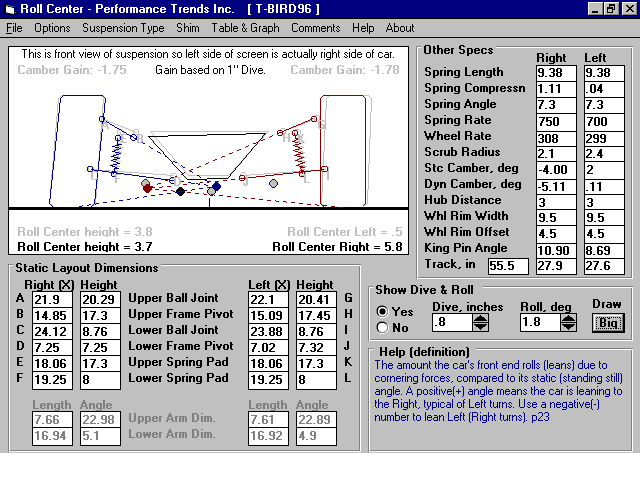
If you take a look at the right side of the pic, you will see the lines in red that I am speaking of (they didn't do a good job of showing line 4, but that's the easy one to understand anyways). The point off to the left where liens 1 & 2 converge is our instant center point, and the rest of the lines show the roll center height calculated by drawing all these lines and doing it for both sides of the suspension. The point of all this...
To find roll center height, knowing that it will basically never be as high as the Cg hieght in a street car, but that the closer we can get to it the less the car will roll during cornering. In fact, if it were possible (practical limits of suspension and car design prevent it) to obtain roll centers above the Cg height, the car would actually roll INTO a corner, motorcycle style. Remember that roll center is simply a pivot point, so if you could reverse the pivot angle by moving the roll center point above the Cg, you would actually reverse the angle of body roll during cornering.
The reason I mention this concept is because I think it's important to know what really happens when a car rolls in a turn. Plenty of people know why sway bars reduce body roll during cornering, but does anyone ever ask why the body is rolling in the first place? Sure it may seem to be obvious, but few people who think they know why body roll occurs know anything about suspension dynamics and roll centers. And there are further complications to these concepts (such as roll axis), but I don't want to dive into anything else until the first post is understood. At any rate, I hope this clears up your questions (you only mentioned that one question), if not just keep throwing them out. Peace!